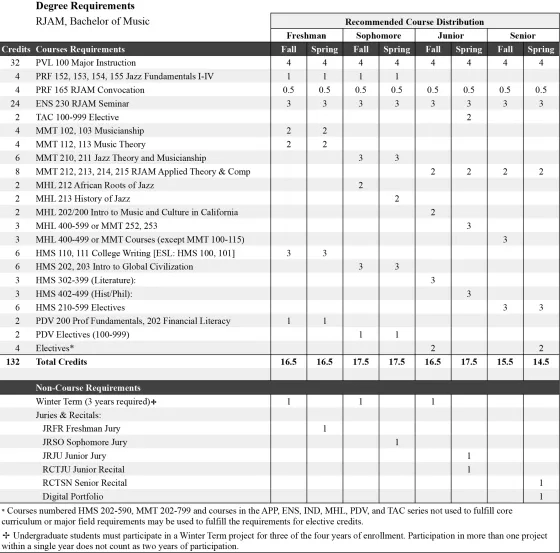
RJAM Bachelor of Music Curriculum

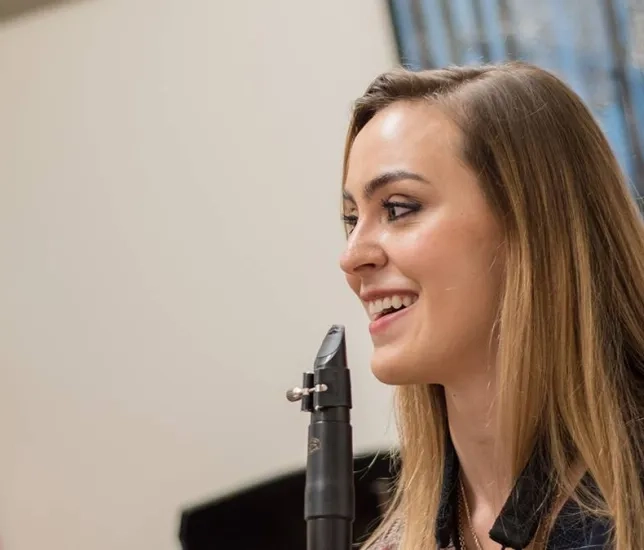
Roots, Jazz, and American Music students perform at SFJAZZ.
Life isn’t an audition.
Any music school can make you a better player. Our interconnected courses are built to transform you intellectually, artistically, professionally, and individually. You’ll understand the roots of your music, freeing you to take it somewhere new. You’ll see how your training broadens your options, rather than narrowing them. You'll find your voice. And you'll enter the world with the same confidence you bring to the stage.
- The RJAM Seminar
- African Roots of Jazz
- Jazz Fundamentals
- Applied Theory and Composition
RJAM Seminar is the dynamic core of the program. Students will hone their skills in improvisation, composition, reportoire, and jazz styles in ensembles of seven to eight students for eight hours each week. RJAM faculty will rotate, working with the different ensembles weekly and sharing their expertise with all of the students.
RJAM Seminar ensembles are year-agnostic: Students in every year of study are mixed in each ensemble. Each group's lineup and instructor rotate every semester, giving students the opportunity to play with as many different classmates in the department as possible under the supervision of as many faculty members as possible. (Every visiting faculty member also supervises a combo, meaning students are given firsthand feedback from working musicians across the country.)
Each month, RJAM students study a different artist from the genre's canon. Accordingly, all students in the department are focusing on the same artist at the same time, with a focus creating original arrangements of the artist's tunes based on the personnel of their ensemble. Students are also responsible for composing an original tune in the style of the artist, presenting a lecture on their work, and transcribing one of their solos to play for the ensemble.
African Roots of Jazz explores the African cultural lineage in American music, the aesthetics and performance practice of varying traditions of the African Diaspora in the Americas, and the preservation as well as the evolution of African music alongside its American descendants.
Jazz Fundamentals aims to introduce and develop skills in three areas including ear training, jazz theory, and jazz and commercial keyboard. Having completed the Jazz Fundamentals sequence, students will move into the upper-level Applied Theory and Composition sequence which encompasses a progressive study of jazz harmony and writing techniques from two part writing to large ensemble composition. Concurrent with Jazz Fundamentals, the RJAM department's Jazz Theory and Musicianship track includes an additional four semesters of genre-specific theory and musicianship to build a solid foundation before students advance to Applied Theory and Composition.
Our approach to shared mentorship is also represented in the applied lesson area, where faculty on a particular instrument collaborate to create a plan of study for their students. For instance, Matt Brewer of the SFJAZZ Collective and Scott Pingel, Principal Bass with the San Francisco Symphony, work together with each of our RJAM bassists. A similar approach is taken with each of the applied study instruments.
A student who chooses the Jazz Composition track will work with mentors such as Edward Simon and David Sánchez to hone their voices as composers while continuing to develop performance skills as members of a lab ensemble. In upperclass studies, composition students will have the opportunity to work with faculty and students in the Technology and Applied Composition (TAC) and Composition programs at SFCM, broadening the palette of professional possibilities for the future.
Access to a wide range of multi-disciplinary electives, including academic courses, round out the four-year bachelor's degree. Off-campus, it is expected that students and their ensembles participate in the numerous opportunities provided through SFJAZZ and in the greater San Francisco Bay Area.
Required Courses
Curriculum: Bachelor of Music in Roots, Jazz, and American Music
Credit Total: 132