Awadagin Pratt's Nina Simone Piano Competition Arrives at SFCM
Simone's great ambition in life was to be a concert pianist: She spent a summer studying at Julliard, though was denied entry into the Curtis Institute of Music.

Awadagin Pratt.
Awadagin Pratt's Nina Simone Piano Competition (NSPC)—dedicated to uplifting Black American pianists—arrives at SFCM for two days of performances in June,
It's a key part of Simone's lore that her great ambition in life was to become a concert pianist. Born Eunice Waymon, she was a child prodigy on the instrument and grew up playing in church in Tryon, North Carolina, but became entranced with the sound of classical music and wholly dedicated herself to it, practicing for hours every day. Her talent was such that her music teacher and community raised money for her to attend a private high school in Asheville; upon graduating as valedictorian, she spent a summer studying at The Julliard School in New York, intent on entering the Curtis Institute of Music in Philadelphia.
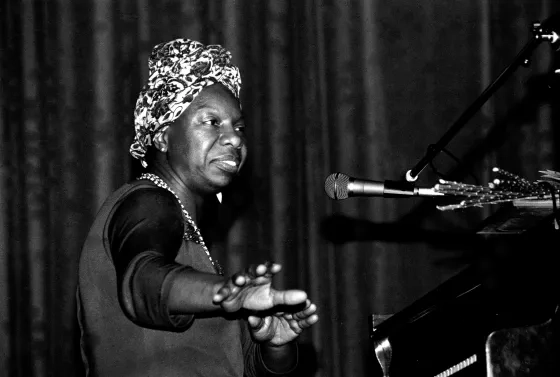
Nina Simone in 1982. (Credit: Roland Godefroy)
Simone always contended that she was rejected from Curtis because of her race, and the rejection inadvertently gave rise to the artist celebrated today. She was teaching piano in Philadelphia but secured a nightclub gig in Atlantic City to supplement her income, and the club owner subsequently told her she had to start singing or she'd be fired. Simone's uncanny ability to improvise and reharmonize songs with a unique blend of gospel, blues, jazz, and classical while singing was near-singular: Miles Davis, after hearing a live recording of her, simply asked, "How does she do it?"
In the spirit of Simone's prodigious musical gifts, SFCM piano faculty Pratt established the Competition with an initial grant from the Sphinx Foundation in 2023. Today, it also includes prizes for best transcription of a recording of Simone's and best performance of a work by an African-American composer. The first two rounds of the competition will be held at SFCM on June 18: The opening round at 1 p.m. and the second round at 7 p.m. The semifinals will then take place on June 19, at 7:30 p.m.; finalists will then perform a concerto with the Cincinnati Symphony Orchestra (CSO) in the fall of 2026.
Of the eight competitors in this year's event, six are brand-new to the competition, evidence of the growing scope of the event, Pratt says. He also notes that 2023 NSPC winner Clayton Stephenson so impressed former CSO Music Director Louis Langrée that, when Langrée transitioned into his Music Director Emeritus position, he invited Stephenson to perform Johannes Brahms' Piano Concerto No. 2 with the CSO in March.
The NSPC purposefully has no age limit, Pratt says. "We want to capture people who perhaps fell by the wayside over time because of lack of opportunity. So we have a competitor in their 40s and another at 31, which is sort of the threshold for aging out of a lot of other piano competitions. Every contestant is an exceptional pianist bringing really interesting repertoire, and I'm really excited to hear them live."
While many other competitions are proscriptive about repertoire, the NSPC is purposefully freer, only mandating that entrants play one composition by an African-American composer. To that end, more (relatively) common names like Florence Price and George Walker (who incidentally graduated from Curtis in 1945 and became the first African-American Pulitzer Prize winner in 1996) mingle on this year's program with others like Betty Jackson King and the Houston Grand Opera's first full-time African-American composer-in-residence, Joel Thompson.
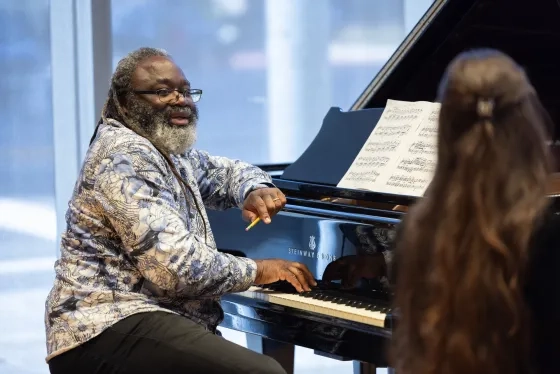
Awadagin Pratt at a masterclass at SFCM in 2024.
The judges panel this year is occupied by San Francisco face Lara Downes (an SFCM Pre-College alum who featured the SFCM Orchestra on a Pentatone Music release), along with Warp Trio pianist Mikael Darmanie (a former student of Pratt's) and Avery Fisher Career Grant winner and frequent Kronos Quartet collaborator Stephen Prutsman.
To hear so many underrepresented composers in one place—not to mention a preview of the potential piano stars of tomorrow—is a fitting tribute to Simone. And Pratt's work related to her continues: Following successful efforts to rehabilitate and earmark Simone's childhood home in Tryon, He'll be performing there in October in a benefit concert for a scholarship established in her name.
Learn more about studying piano at SFCM.