Pre-College
voice

Trio of SFCM Students Win $18K in Awards from Lorenzo Foundation
July 3, 2026


Courses Taught
Pre-College Musicianship, Level 5
Private composition lessons
Education
MM, San Francisco Conservatory of Music
BM, University of the Arts
Post-study, Franz Liszt Academy, Budapest, Hungary
Awards and Distinctions
2020 Ruth Boshkoff Prize for choral composition (Organization of American Kodály Educators)
2015 The American Prize (finalist) – "City Walks" for string quartet
2000 Highsmith Award (SFCM) for orchestral composition – "Misterium Tremendum"
What is your hometown?
Washington, D.C.
What are you passionate about outside of music?
Languages, history, and theater.
Who were your major teachers?
Conrad Susa, János Vajda, Joseph Castaldo.
What question do you wish students would ask sooner rather than later?
I would love for students to ask how the ear training and theory we cover in musicianship classes connect to the repertoire they’re learning. These skills aren’t separate from “real music”—they can help students learn more quickly, understand more deeply, and become more independent musicians.
What was the defining moment when you decided to pursue music as a career?
I’m not sure there was one defining moment, but learning the music for an ill-fated high school production of Sweeney Todd was probably close. That experience led me deeper into Stephen Sondheim’s music, and having something so vivid and concrete to try to emulate helped steer me toward composition when I was otherwise a rather rudderless musician.
What was a turning point in your career?
While I was still a graduate student at SFCM, I had the opportunity—outside the Conservatory—to write a commissioned piece for chorus and chamber orchestra, with Conrad Susa’s guidance. Hearing that work succeed in performance gave me confidence that my music had a future, and helped me begin to see a path forward as a composer.
If you weren't a musician or teacher, what do you think you would be doing now?
Definitely something to do with languages. I’ve studied several over the years, and I’ve been fascinated by them since my teens—around the same time I became seriously interested in music.
If you could play only three composers for the rest of your life, who would they be?
Maurice Ravel, Béla Bartók, Stephen Sondheim.
What is your unrealized project?
I’d love to write a full-length opera or music-theater work. I’m drawn to pieces where music, language, character, and dramatic structure all have to work together. Theater is where I first found my way into music, and that dramatic impulse still runs through much of what I write.
What recordings can we hear you on?
String Quartet No. 1 ("City Walks")
Juventas New Music Ensemble, THROUGHLINES (Navona Records)
Tumbalalayka
Quatuor Aesthesis, O DO NOT MOVE
American Standard
TIME PIECES: 60 Years of American Music (Clarinet Classics, UK)
Videos:
My musicianship classroom teaching is heavily influenced by my years studying in Hungary and I have adapted many Kodály-flavored techniques emphasizing strong inner hearing, musical memory, flexibility and independence. Placing a high value on students' enjoyment of music making, with and without an instrument, my class is fun and relaxed, but also very challenging."
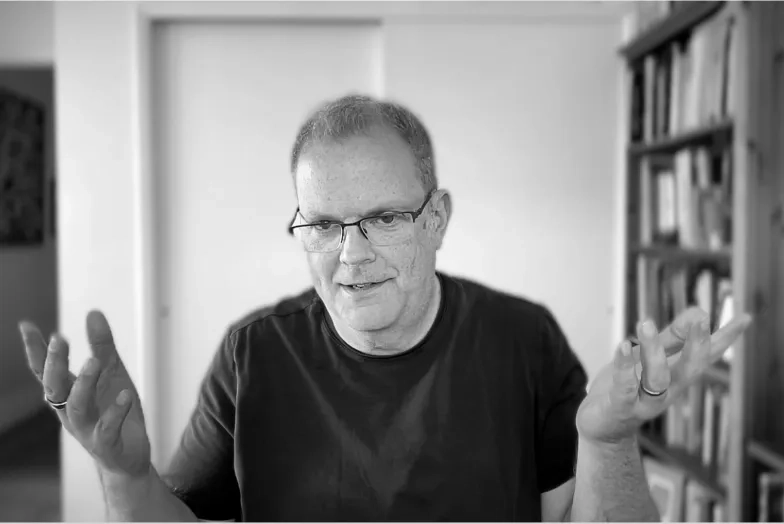
Active as a composer, teacher, and arts administrator in the San Francisco Bay Area, Michael Kaulkin writes choral, orchestral, chamber, and vocal music performed by ensembles across the United States and abroad. His String Quartet No. 1 (“City Walks”), a finalist for The American Prize in Chamber Music, was recorded by Juventas New Music Ensemble for the Navona Records album THROUGHLINES, released in May 2026. His newest choral work, Song of Becoming, is scheduled for premiere by the Southern Arizona Symphony Chorus in December 2026.
In the Bay Area, Kaulkin’s music has been performed by the Oakland East Bay Symphony, San Francisco Choral Artists, Mission Chamber Orchestra, LIEDER ALIVE!, West Edge Opera, and others. His choral arrangement “Tumbalalayka” has been performed widely in the U.S. and internationally, and appears on the French vocal quartet Aesthesis’s album O Do Not Move. “American Standard” for clarinet and piano has also been performed widely and is included on Time Pieces: 60 Years of American Music, released by the UK label Clarinet Classics.
Kaulkin holds an M.M. degree from the San Francisco Conservatory of Music, where he studied composition with Conrad Susa, having previously studied composition and choral conducting at the Franz Liszt Academy of Music in Budapest, Hungary. A member of the Musicianship and Composition faculty of SFCM’s Pre-College Division since 2008, he has also taught at The Crowden School, the Ruth Asawa San Francisco School of the Arts, the Academy of Art University, and summer Kodály programs at Holy Names University and Portland State University.