Los Angeles Philharmonic Principal Timpanist Joe Pereira Joins SFCM
Prior to arriving in LA, Pereira played timpani and percussion in the New York Philharmonic from 1997 to 2008.

Joseph Pereira (Courtesy Los Angeles Philharmonic).
Joe Pereira brings an impressive set of credentials on both sides of the country to the San Francisco Conservatory of Music's Percussion Department, where he'll begin teaching timpani in the fall of 2026. Currently holding the Principal Timpani chair in the LA Philharmonic, he relocated for the job from New York in 2008, where he held the Assistant Percussion and Timpani chair with the New York Philharmonic since 1997.
"We are excited to welcome Joe Pereira to the percussion faculty at SFCM," SFCM Percussion Department Chair Jacob Nissly says. "His work as a timpanist, percussionist, composer, and chamber musician makes him an ideal addition to our faculty. We look forward to having him start in Fall 2026!"
Pereira is also a composer, having double-majored in that field as well as percussion at Boston University. He won his job with the NY Phil while still enrolled in graduate school, and though he received conflicting advice as to whether to drop out, continued his studies part-time while playing in the Philharmonic.
"I often joke with colleagues and friends that that was actually like the hardest time of my life," Pereira recalls. "I had obviously spent a lot of time practicing for the audition, but I had no experience actually doing the job, so there was a huge learning curve."
It's a difficult position in any orchestra or symphony, Perieira says, "because you're covering for the principal timpani if they get sick, plus percussion in the rest of the program. So you're basically playing everything all the time. And with a big orchestra like the New York Phil, you have to learn the traditions of how things go and you just get on the train and try to figure that out on the job. So I learned a lot of stuff and also messed up a lot."
Pereira's first instrument was actually piano—usually the instrument of choice for a composer—but he says, "I never really understood the idea of composing as a younger musician." The first piece that struck him was Béla Bartók's Concerto for Orchestra, which he used to obsessively listen to on his 90-minute commute to New York Youth Symphony rehearsals: "I was completely blown away the first time I opened the score, like, 'Wow, I can't believe somebody wrote all these notes,' along with 'I really want to do this.'
Alongside his interest in composition, Pereira absorbed other percussive influences throughout his studies: His undergraduate studio teacher had him transcribe solos from jazz vibraphonist Lionel Hampton to develop a better sense of pitch to navigate the timpani, and he studied the pandeiro, a Brazilian tambourine used in samba music, "which really helped with my orchestral tambourine technique."
In assessing potential students, Pereira's must-have is a sense of curiosity. "You don't have to come in and be the most talented, amazing player in the world. I think if you're curious about the music and you're honest with yourself and you work really hard, you'll be successful. I almost guarantee that to my students now."
However, "I never have a predetermined program," he says, "because everybody has different strengths and weaknesses." Timpani presents a special challenge for percussionists, Pereira says, because of the drums' variable pitches, which a player controls with foot pedals, so a well-developed ear isn't a bonus, but a necessity. "Timpani can be a very strange thing because you can be the most musical person in the world, but it doesn't matter if it's not in tune," Pereira says. "Or in time. Professional auditions, the number one and two comments from committees are, 'It's not in tune,' or 'The time is bad.' That's it: It's never 'Oh, the phrasing is a little bit off.'"
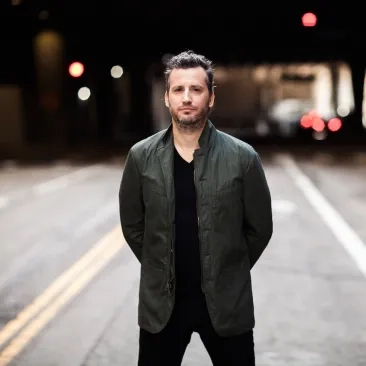
Joseph Pereira.
Playing large-scale instruments like timpani is a physically demanding job, and Pereira remembers an important lesson from watching other instrumentalists in the Philharmonic. "At the time it was not a great hall: You had to really slam your instrument, use bigger, heavier mallets, bigger cymbals and really hit things hard," he says. "But I noticed the great soloists that came and played with us—violinists, pianists—they looked really relaxed and they had a huge sound. Part of that is their instruments, of course, but I think a lot of it has to do with their technique. So now when I notice students at the instrument looking at the music and really focusing on, 'I have to play the right notes,' everything gets stiff and we have to work on opening that up a bit."
Pereira's time in New York dovetailed with SFCM Percussion Department fellows Haruka Fujii and Chair Jacob Nissly, "which was one of the big reasons for me in accepting this position was that I know they're great players and great people, and I think we could we could build something really special together." Like Fujii, Pereira developed a collection of exotic drums and odd instruments, and remembers going into a Manhattan Pottery Barn with a tuner to examine wine glasses he could treat as instruments: "An employee would be like, 'Can I help you?' and I'd have to answer, 'Sorry, but there's actually no way you can. I just need some quiet so I can hear these.'"
Learn more about studying percussion at SFCM.