SFFILM Filmmakers and SFCM Students Premiere New Works at Sound & Cinema Showcase
Three independent filmmakers pair with composers and sound designers studying at SFCM to premiere short films at the Conservatory during the San Francisco International Film Festival.

SFFILM and SFCM's Sound and Cinema premiere.
That's a wrap: Three SFFILM-supported independent filmmakers premiered new works created with SFCM students in April at a sold-out event held in the Conservatory's premiere Studio G.
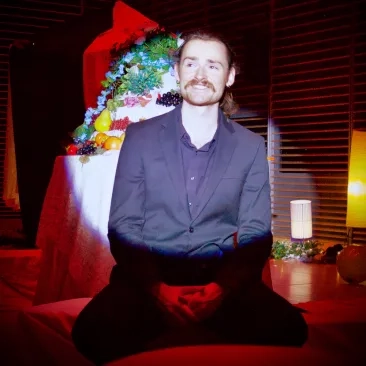
Thomas Stenzel.
For the second annual Sound & Cinema Showcase, in partnership with the San Francisco International Film Festival (celebrating its 69th year in 2026), students in the Technology and Applied Composition (TAC) Department were paired with SFFILM-supported directors to carry their projects over the finish line. Students handled everything aural for the films, from original scores to dialogue mixing and sound design.
"I remember I went to one of the SFFILM social events on a whim and I was like, 'Oh, this is where all the creative weirdos making interesting art hang out,'" TAC student Thomas Stenzel laughs. "I love the community. I think that everyone is just really down-to-earth and it's a great mix of mutual respect, like nobody's 'higher' than anyone else."
Not only an SFFILM intern, Stenzel ended up working in some capacity with all three directors included this year: Andrés Gallegos (The Darkest Night), Elivia Shaw (Breathing Room), and Maria Victoria Ponce (Perm and Circumstance). "All of the directors are so talented and creative in their own ways, and they're just really inspiring to talk to," he says. "Getting to work with a director more personally, is a wonderful experience: The process of translating what they want is sort of like a puzzle, and so then when you get it just right and submit and they say, 'Perfect…' huge dopamine hit."
Student Matt M. Jacobson brought a considerable amount of experience to Gallegos' film, having majored in tuba performance as an undergrad before pivoting to work in post-film sound via a yearlong program at Vancouver Film School. "I didn't know a ton about the TAC program when I got into it," he says, "and then it was one of those moments where I realized that in my first semester here, only just a quarter of the way through the semester, I was like, 'This is the perfect program for me.'"
Maria Victoria Ponce's Perm and Circumstance was inspired by a story from her husband: "When he was around 12 years old, he asked his mom for a perm. And this was back in the Eighties, and he wanted to look cool in front of his classmates, but his mom ended up doing it herself and it didn't turn out how it was supposed to, and then he had to go to school with it and kids made fun of him." Born in Mexico and raised across the Bay in Richmond, Ponce's work explores issues of Latino/e identity. "I tend to do shorts with a female or a girl protagonist, and a lot of coming-of-age stories primarily, so having a lot of my male colleagues and female colleagues tell me how much they related to this story and how it took them back to being that age was exciting."
Ponce asked students inspired by 1980s synthesizer sounds, particularly those coming out of the iconic Roland TR-808 Rhythm Composer. "I gave them a playlist of music that had inspired me, so they were able to listen to that and start coming up with music that they believed could work well for it based on our initial meetings," she says. "They caught on to the vibe I was looking for pretty fast, which is really cool. What was also nice was that, sometimes, I couldn't express exactly what I wanted, but just by the language that I was using they were able to translate that and make it into something that was a bit more understandable when it came to music."
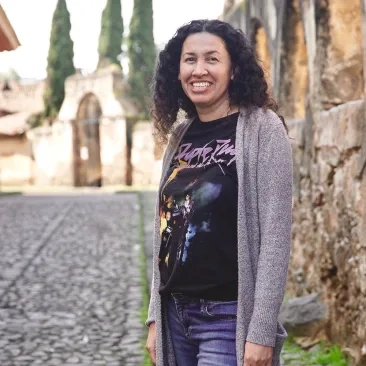
Maria Victoria Ponce.
Elivia Shaw's short Breathing Room (part of a planned feature-length project) focuses on the struggles of agricultural workers in California's Central Valley. "I've been working on a feature film there for three-plus years, trying to make a film that connects environmentalism and healthcare," she says. "In terms of sound I think that really meant creating a sense of music that is powerful but doesn't do all of the emotional work for you. As a documentary director, I feel the music should support what you're already feeling but it shouldn't do the work of, or overpower, the more subtle images onscreen."
Shaw says many of her previous work with composers had been as an editor or producer, so this year presented her with the first opportunity she's had to build a score from the ground up. The lead composer on her film, Diego Carrillo, who has also spent time in the Central Valley, "was so easy to work with," she continues. "We sent samples of the film and he just started iterating. We pretty quickly really loved what he was doing, to be honest with you."
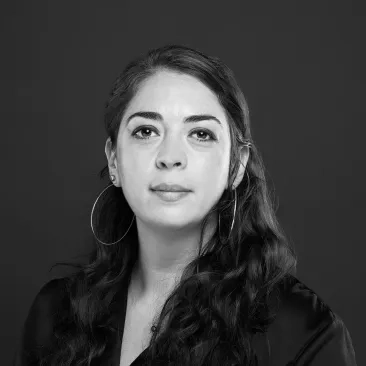
Elivia Shaw.
"In this case, letting Diego do his thing paid off," Shaw continues. "I tried to imagine what the music was going to be, tried to pick out references and think of genres of music that thematically fit in, but at the end of the day, his emotional response while writing music to the scenes worked a lot better. Hopefully I get to work with more composers who I can just give the information I want to get across and then let them respond to the material."
Of his collaboration with Gallegos, Jacobson says, "Part of the reason why I wanted to come here was to make connections through places like SFFILM and with people like Andrés; a structure that allowed for is really valuable to me."
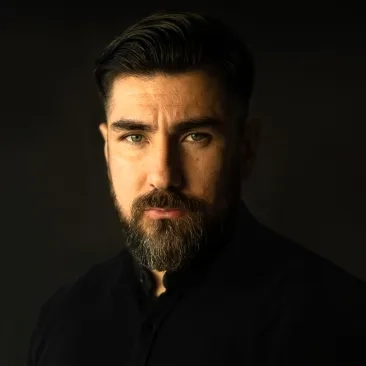
Andrés Gallegos (Credit: Constanza Hevia).
"I really liked Andrés''' film," Jacobson continues. "It was very dark. He wanted a lot of sound design elements to be mixed with the score and that's definitely much more my style." Jacobson worked with Rafe Axne, a veteran of the SFFILM partnership and Gallegos' lead composer.
"Rafe and I work great together," Jacobson adds. "We've actually been working on other films together, just volunteering to do sound to get more connections. He's really great at understanding the narrative and then making music that not only reflects that narrative but actually has sound design elements within the compositions on a subliminal level."

Matt M. Jacobson.
Students pitched filmmakers their concepts at an initial meeting and were assigned from there, and Gallegos remembers, "It was wonderful to see the variety of visions for my film; actually really overwhelming to digest so many creative possibilities for it at once."
"Matt coordinated dialogue, cleaned up production sound, mixed, created foley sounds, and ambiences, which was all pretty impressive," Gallegos adds. "The team had many sessions, where for example, they'd be creating the sound of the clothing of actors moving across each frame. It was pretty incredible, and overall I feel very grateful for what they did."
"Matt and Rafe and I had many, many meetings, just to talk about my intentions as a filmmaker," Gallegos says. "I'm Chilean, Latinx, but I wanted to not, for example, have stereotypical folk instruments you'd typically hear to evoke that. So we went with a genre approach, having fun with action moments or psychological thriller moments instead of always having 'dramatic' music with traditional Latin American instruments."
Gallegos says Jacobson and Axne also composed some of the diegetic music (music heard as part of the action onscreen rather than the soundtrack) heard in the film, which required them to work backwards in time on a different continent. "I believe it's six or seven tracks completely created by the team that we hear on radios. The short takes place in 1996, and the music people used to listen to in Chile at that time was kind of '80s and '90s. And the team did an amazing job, using synths and mixing it to the sound quality of that era."
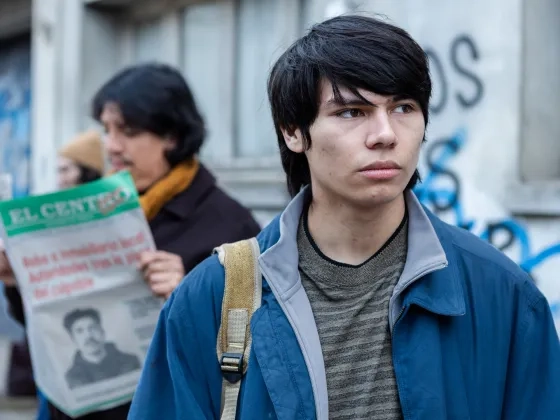
A still from Andrés Gallegos' 'The Darkest Night.'
Reflecting on the project, Stenzel says, "Film is 24 frames, 24 little canvases, per second, plus audio, plus the narrative. That's just so huge and it can be intimidating, but the people I've met through SFFILM aren't intimidated by it, they're fluent with it and know exactly what to do with it. I just really enjoy trying to figure out exactly what they're talking about and then translating it into music, and that's helped reinforce my own musical understanding as well."
Learn more about studying Technology and Applied Composition at SFCM. The San Francisco Film International Festival runs until May 4.