Where Ravel Meets Raga: All About SFCM's First Collegiate-Level Indian Classical Music Offering
The Winter Term workshop concludes with a lecture from video game composer Yu-Peng Chen on integrating non-Western instruments into traditional scores.

Arjun Verma (right) and Haruka Fujii.
What do composers and musicians like Alexander Scriabin, Philip Glass, Yehudi Menunin and Daniel Hope have in common? They've all studied Indian classical music—and SFCM is making it easier than ever for students to join that lineage.
Indian classical music is one of the world's oldest musical traditions, and its dizzyingly complex rhythms and melodies can be daunting, but SFCM has a geographic ace in the hole: The Ali Akbar College of Music, located about an hour north of San Francisco. Founded by its namesake sarod virtuoso, the College is represented at SFCM by sitarist Arjun Verma, who studied directly with Akbar.
"I'm very honored to be the first faculty member from Ali Akbar teaching at the collegiate level at SFCM," Verma, who has previously given Pre-College lectures, said. "We really want to just share the passion for this music that we all have and give that passion legs for people who respond to it for their own professional work and enjoyment." This workshop is part of SFCM's annual Winter Term, a special time for students to immerse themselves in subjects beyond the standard curriculum.
Percussion faculty Haruka Fujii (below right) will be teaching the three-day course with Verma. Though she and Verma actually share a common instrumental background in the marimba, Fujii's career takes a zoomed-out view of percussion. Co-Artistic Director of the GRAMMY-winning Silk Road Ensemble (founded by iconic cellist Yo-Yo Ma), Fujii has studied and pulled from multiple percussive traditions, and now calls Silk Road tabla player Sandeep Das "brother."
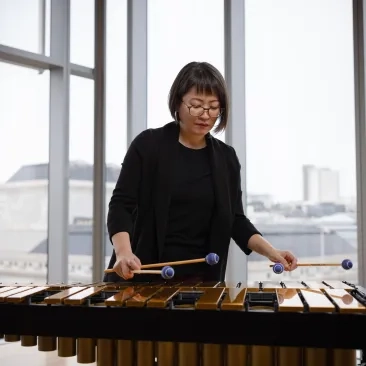
"The pieces that he brings to Silk Road require a certain understanding," she explains. "I can analyze them in a way that I can understand with Western classical music training so I can write it down and memorize it, but when we then play together, it won't sound quite right. That's because you really need to get deeper into that culture and the traditions of rhythms."
"So Arjun will introduce that and share, and my function will be to just keep poking at it from the Western classical training side," Fujii laughs. "How do we find a commonality and a key to collaborate? How do we make a language out of our separate traditions to create something together?"
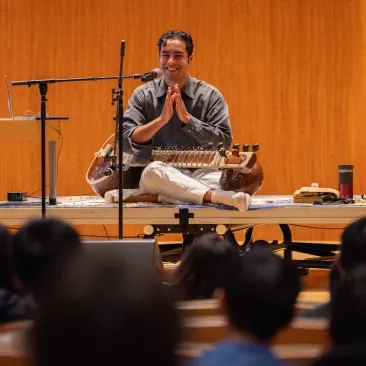
Arjun Verma.
The class will be using material from Verma's cross-genre project The Resonance Between, performed at SFCM in 2025, to help jump-start students' practical understanding of the foundational concepts of Indian classical. "As with Western classical," he says, "you have to train for years in fundamentals until you get to 'the good stuff.' There still aren't any shortcuts around that, but to give people a taste of the music beyond the basics, we're using some of the repertoire from The Resonance Between, which is a combination of Indian and Western classical music. Since that's all scored out and written out, we have something to put in front of students they can play. Then we sort of step back and start to take it apart and look at the music through that lens."
The class will conclude with a visit from composer Yu-Peng Chen, a film and video game composer best known for scoring the game Genshin Impact. Chen recruited Verma for that project, and Verma was able to pull him in to speak to students about Chen's work fusing traditional, non-Western instruments with traditional Western classical scoring. "Genshin Impact was recorded with the London Symphony Orchestra and mixed at Abbey Road Studios; it was an amazing project and has had huge reach. I thought I'd bring him in for a moment since he happens to be in town just by the stroke of luck and I know several of the Composition students, especially in the TAC (Technology and Applied Composition) program are very familiar with his work and will be very excited to meet him."
Though Indian classical music really only started to become highly visible in the U.S. in the 1960s thanks to elements of it being adapted by musicians like George Harrison of the Beatles, it's much more common nowadays to hear the sounds of tabla drums or Hindustani vocals in film scores and pop music. "Students are very likely to come across elements of Indian classical in their music careers at this point," Verma says, "so having some familiarity with the rhythm or melodic ornamentation is going to help them in those situations." Fuji adds, "knowing there are different systems and different approaches to creating grooves and even just counting rhythms enriches your understanding and appreciation of music itself, no matter the genre."
Learning the rhythmic structure of Indian classical—which uses often-irregular groupings of beats to mark sections and melodic shapes rather than Western classical's strict measures and bar lines—is going to expand a student's sense of time in their own playing, even if they're dedicated to, say, the Baroque repertoire. The same goes for the melodic ornamentation used in Indian classical.
Students don't have to even dive that deeply to get the benefits of learning about another culture's musical practices, though. As Verma says, "Music is music at the end of the day, but you can unlock a lot more ability by approaching it in different ways."
Fujii adds, "It is about learning this specific genre of music, but I want students to see how music-making can apply to how we live in our society, how to be curious about different traditions that you don't belong to and learn something about what's on the other side of the walls we have."
Learn more about studying at SFCM or its annual Winter Term.