A Composer, a Dean, and a 20-Year Anniversary for the Guitar Ensemble
Composer and guitarist Steve Mackey has a close relationship with SFCM's Guitar Department, which performed a piece of his with a special guest bassist, along with a performance with the SFCM Orchestra.

The SFCM Guitar Ensemble.
Composer Steven Mackey brought back old memories with his recent residency at SFCM, but also helped the Conservatory mint some new ones.
As part of the Andrew Imbrie Composer-in-Residence program at SFCM, Mackey's visit included seminars with the Composition Department, one-on-one coaching sessions with students, as well as the performance of his work Urban Ocean at the SFCM Orchestra's February concert.
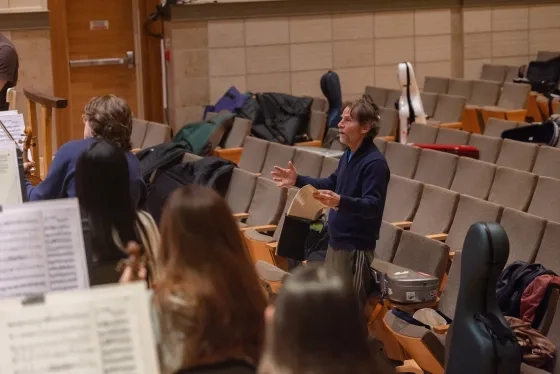
Steve Mackey offers feedback to the SFCM Orchestra.
But Mackey's first ties to SFCM came via the Guitar Department, and in particular, one special piece: Measures of Turbulence. Performed with five nylon-string "classical" guitars, two electric guitars, and one electric bass, Turbulence was commissioned through Guitar Chair David Tanenbaum to help open the Conservatory's then-new location at 50 Oak Street, where it moved after years of operating at 1201 Ortega.
The electric bass for that performance was played by SFCM's current Dean, Ryan Brown, who had just graduated from SFCM. "I've been a guitarist since junior high, and a lot of my pieces are composed for guitar," Brown recalled. "When I graduated in 2005, I immediately joined the staff full-time running the box office, so I was here when we opened the building, and then when David Tanenbaum commissioned this piece from Steve, he asked me to play bass on it because he knew that I played."
Brown asked Mackey for an informal lesson while the composer was in town, and, in his words, the pair "really hit it off: We're both from California, we both play electric guitar, we both got into composition relatively late." Based on that lesson, inspired by Measures of Turbulence and with Mackey's encouragement, Brown applied for a post-graduate degree and moved across the country to study with Mackey.
Twenty years later, Brown picked up the bass guitar again for Turbulence, taking the stage with the SFCM Guitar Ensemble for its February recital.
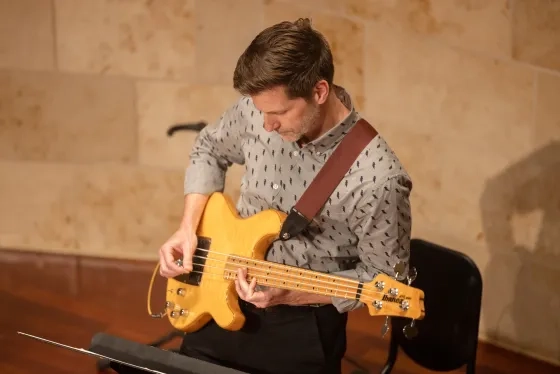
Dean Ryan Brown with the SFCM Guitar Ensemble in 2026.
"The crazy timbres and textures and rhythms Steve was able to get out of the piece while still being very melodic… it's been in my head constantly since I started picking it up again," Brown says. "It's shocking, because I keep thinking, 'Oh, when we did this five or 10 years ago…' and it's been 20 years. It feels like no time has passed at all, especially David at the podium and Steve in the room."
Brown continued, "I love how full circle I've come with this piece. It's the reason I went to Princeton, and the Conservatory is the reason I was even able to do that, because being here even as a staff member gave me the access, which gave me the opportunity. There's a lot of warm feelings around every aspect of it. It really just makes me love Steve and David and the Conservatory all the more because it's just so enriching for everybody."
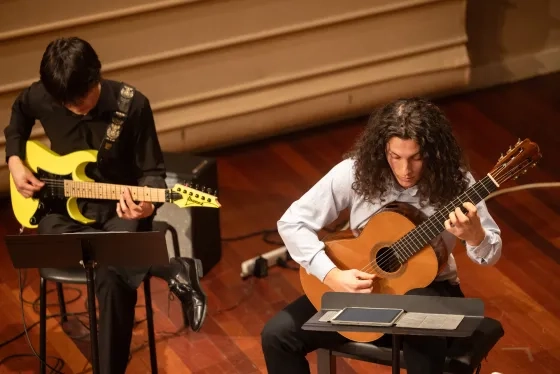
SFCM students perform Steve Mackey's 'Measures of Turbulence.'
"Twenty years ago the SFCM Guitar Department commissioned Steve Mackey to write Measures of Turbulence," Tanenbaum says. "The piece is complex and exhilarating, a parade of exotic and unusual sounds. I thought then and still think now that it's one of the greatest guitar ensemble pieces in the repertoire, even if few ensembles have dared play it. But SFCM dares."
"The piece is really hard," Mackey adds. The electric guitar parts require a very precise left- and right-hand technique, and the sounds they're playing can't be replicated on a nylon-string guitar. "There's no margin for error with those," Mackey continues, "and then the classical guitar parts are really hard. But the students did a great job with the musical conversations, imitating and doubling and answering each other."
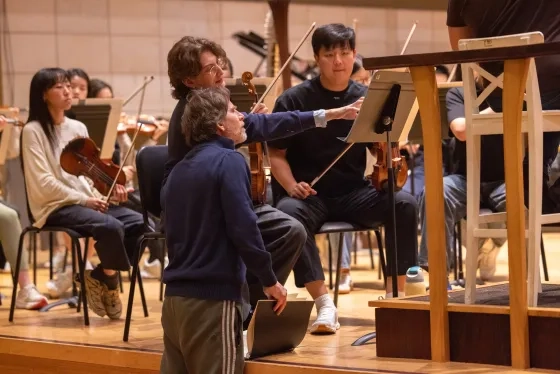
Steve Mackey works with a violinist on 'Urban Ocean.'
Mackey grew up a self-professed "shredder," learning guitar by copying Jimmy Page's Led Zeppelin riffs and John McLaughlin's searing Mahavishnu Orchestra leads. "I was into so-called psychedelic rock, music to listen to on headphones at 2 a.m., lying on my back on the floor of my bedroom," Mackey said. "I really wanted to go someplace. Then when I heard classical music for the first time, I thought, 'This is the most psychedelic rock I'd ever heard.' I mean, Beethoven's Ninth, or Rite of Spring: Those became the most out-there music I'd ever heard."
But Mackey quips that he "repressed my guitar background" when he began training as a composer after switching from a physics major in college. "I was 'masquerading' as a serious composer, and there weren't any guitarist composers. I really didn't play much; I had a time when I regretted my background. It was only really when I got out of school and no one was paid to be interested in my work anyway that I picked up the electric guitar again."
The SFCM Orchestra also performed one of Mackey's works, Urban Ocean, though it came from a markedly different source. Urban Ocean was commissioned by the Aquarium of the Pacific in Long Beach, California, and Mackey says it "deals with this dialectic of marine life in this mysterious, deep, dark world, and then this kind of razzmatazz of daily life on the terrestrial side of things."
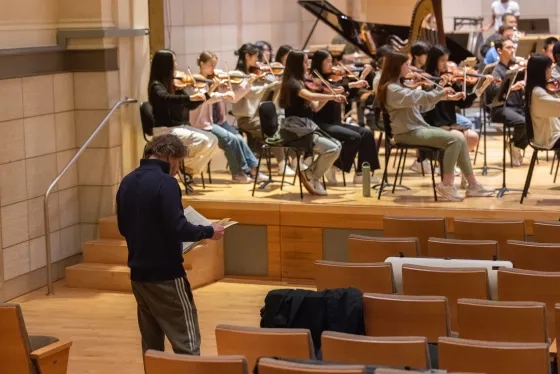
Steve Mackey at an SFCM Orchestra rehearsal.
Mackey also held individual coaching sessions with composition students. "A successful lesson is when somebody's excited to go and compose when they leave," he says. "I put a lot of emphasis on the creative process, about sketching and improvising and other ways of developing material."
Mackey also says he's a firm believer in "no guilty pleasures" regarding composition. "You can love K-pop and Olivier Messiaen," he says. "When students tell me about their secret passion for some kind of music they feel like they shouldn't have, I try to knock those voices off their shoulders, the voices that are saying, 'You can't do that in concert music, this is serious music.' Classical music should be inclusive, music that aspires to distill all of life into a listening experience."
Learn more about studying Guitar or Composition at SFCM.