'You Must Live as Art Itself:' SFCM Celebrates the Class of 2026
Graduating singer Natalie Sweeney performed a Michael Tilson Thomas composition, 'Grace,' with '05 graduate Teddy Abrams.

SFCM's graduating class of 2026.
As America prepares to celebrate its 250th anniversary, SFCM started the party a little earlier, conferring 158 degrees and bidding a fond farewell to its Class of 2026.
"I want each of you to know how honored I am to be the first person who gets to say to you today, 'Congratulations: job well done!'" Executive Vice Chair of SFCM's Board of Trustees David Kremer said in his opening remarks to the class. "Each of you has worked hard and can take great pride in what you have accomplished. Each of you is well prepared to meet the challenges that lie ahead. And very shortly, each of you will receive the piece of paper that makes it official. You will forever be a member of the SFCM family and you will always have a home here. And so I say to you: 'Welcome to the family.'"
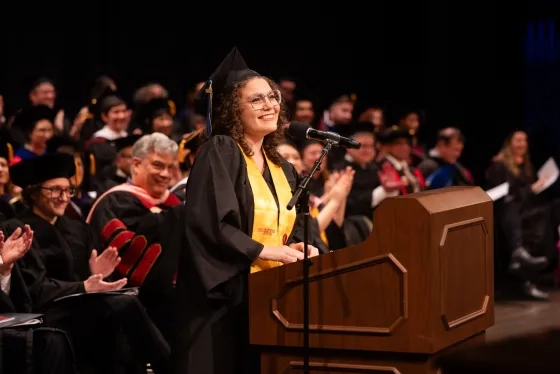
Clara Abrahams.
The Class of 2026 elected Clara Abrahams as its undergraduate speaker and Chong Li for its post-graduates. Abrahams, a Voice graduate who studied with Rhoslyn Jones, extolled the Conservatory's tight-knit community, asking her classmates to "recognize how lucky we are to know everyone by name." She continued, "SFCM is a very small school. This isn't normal. But I think we are better off for it. You can't make music or art by yourself, no matter how hard you might try. It's simply not possible. Everyone you will ever meet will change you in some way."
"Our art, our music, whatever it is we end up doing, will, at some molecular level, be touched by whom we’ve met over these past four years," Abrahams said. "There's a certain beauty in knowing everyone. If the school had been bigger, if we had been more separated, my life wouldn't be as rich."
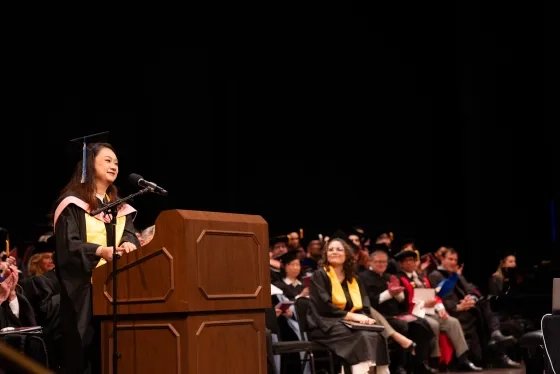
Chong Li.
Li, graduated from the Technology and Applied Composition Department, similarly highlighted SFCM's community, focusing on its multiculturism and diversity. "We come from all over the world, with different languages, cultural backgrounds, life experiences and artistic understandings," she said. "Here, we meet, learn, collaborate and inspire each other. In this process, we communicate in a special way: an expression that transcends any language, and it is called music."
To close her speech, Li offered a blessing in Mandarin that translates to, "The world is wide, the future is open, and the days ahead are still long."
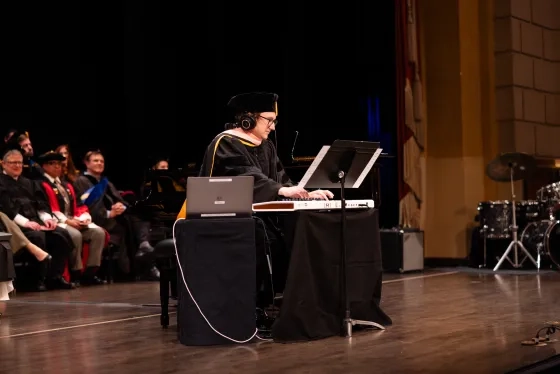
Teddy Abrams.
For his address to the graduates, GRAMMY winner Abrams bucked convention by beginning with a musical performance that sampled past speeches given by honorary degree recipients at past SFCM commencements, set to music composed by student Megan Gürer. In his speech, he told the Class of 2026, "only you can see the ways in which you will be needed—the ways in which you can help fit the world together. The essence of education is self-motivated. Same for creativity and art. The minute you fall into the routine of production, the furrow of profession, you lose the sacred title of artist and become something different—something unnecessary, expedient, and quite possibly unneeded."
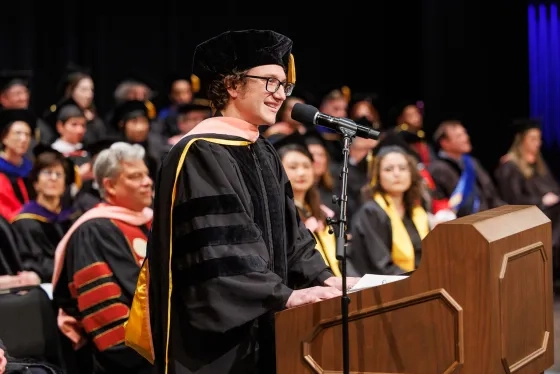
Teddy Abrams.
"Remember," Abrams continued,"You can and will be inspired by others, but only you can find the spark and light that precedes creation and revelation. Thus you must live as art itself, as a poem or a song."
Hailed by The New York Times as "a maestro of the people" for his work as Music Director of the Louisville Orchestra (LO) and represented by SFCM's alliance partner Opus 3 Artists, Abrams and LO will also be appearing on another of SFCM's alliance partners, Pentatone Records, via the upcoming release The Year of Silence.
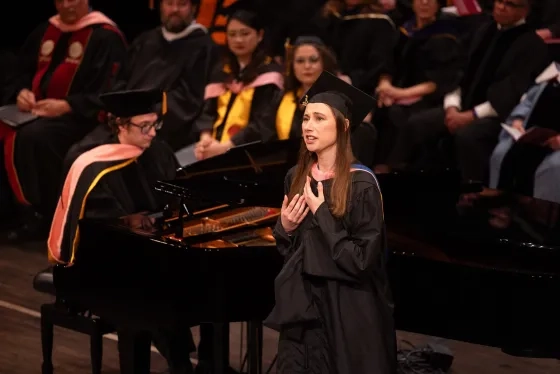
Teddy Abrams and Natalie Sweeney.
For a school and city still fresh from the loss of iconic composer and conductor Michael Tilson Thomas (MTT) in April, Abrams' performance of "Grace" with Sweeney was especially poignant. MTT originally composed the piece for Leonard Bernstein's 70th birthday, and MTT wrote that Bernstein "asked that we sing it before meals and gatherings during that final period of his life." For Abrams, who at 9 years old was so inspired by a concert MTT gave with the San Francisco Symphony that he wrote the conductor a letter—which MTT answered—the performance became a full-circle moment in which Abrams assumed a mentorship role for a younger generation of musicians.
"I stand here today because of Michael," Abrams said during his speech. "Our artistry is the living legacy of the innumerable people who have guided us. We are a living heritage, a superstructure of artists across time and space who have all tried to fill in the gaps between the notes. May I remind us all of the sacredness and beauty of that legacy, that heritage? Can we celebrate the wonder of a practice that lets the dead speak, the distant become present, and the voiceless be heard? How fortunate we are, indeed."
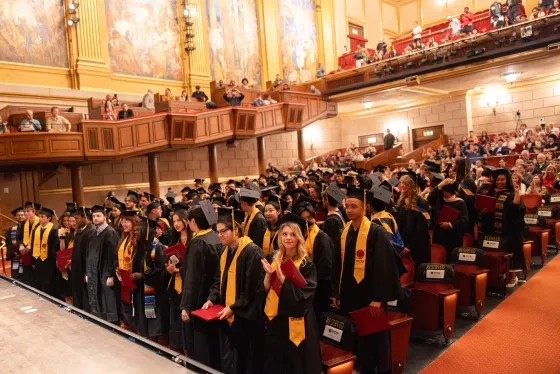
SFCM's Class of 2026.
Following Abrams' remarks, SFCM Provost Jonas Wright delivered the undergraduate Provost's Award for Academic Achievement to Vidyuth Guruvayurappan (who studied with Paul Welcomer) and the post-graduate President's Award for Academic Achievement and Leadership to Carly Passer (who studied with Susanne Mentzer).
In his closing remarks, SFCM President David Stull underscored how Conservatory students are distinguished from their peers across the country: "On this expedition going forward you have to keep certain things in mind about yourselves first and foremost. Very few graduates in this country sitting in rooms just like this have worked as hard as you have to get the diploma right now. Almost none."
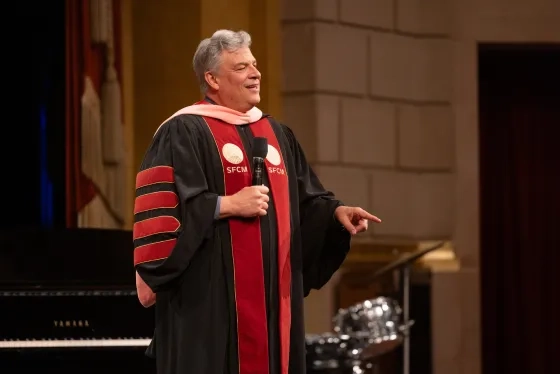
SFCM President David Stull.
"I assure you they weren't spending six or eight hours in practice room," Stull continued. "I assure they weren't playing a studio class. I assure you that the transparency of their work and their advancement wasn't for everyone to see in their schools. They quietly majored in things, turned in assignments, did well, didn't do well—but the accountability, the transparency, the focus, the laser beam of 'Can you do it or not?' has not been trained on them the way it's been trained on you. It just hasn't been."
"So when people ask you, 'What did you do at your school?' You can say, 'Everything that you didn't, pretty much.' And that's a fact. I'm happy to say that right now to Stanford down in Palo Alto right now," he quipped.
After diplomas were awarded, students from the Roots, Jazz, and American Music Department performed Roy Hargrove's "Top of My Head" as the recessional to close out the Conservatory's 2026 Commencement. Trumpeter Hargrove, hailed as a generational talent before his early passing in 2018, wrote a rare vocal part for himself on the song, which includes a fitting send-off for the Class of 2026: "There's a song inside my heart … sing it loud and sing it free."