How SFCM Helped Jake Heggie Perfect His GRAMMY-Winning Opera 'Intelligence'
An SFCM workshop helped Heggie realize the ending to the opera needed to be scrapped and reworked.

Composer and SFCM professor Jake Heggie.
"Third time's the charm," Jake Heggie jokes of his 2026 GRAMMY win for his Civil War-era opera Intelligence.
Previously nominated in 2019 and 2022, Heggie workshopped his 10th full-length opera, Intelligence, at SFCM as well as Opera San Jose and University of Colorado Boulder. (The work was commissioned by Houston Grand Opera.) "More than anything," he says, the GRAMMY "is an affirmation to all the hundreds of people who worked and walked alongside this piece for eight years from the initial concept to realization. It was a tri-state effort, and that takes a lot of people who donated and contributed and participated."
With librettist Gene Scheer, Heggie set the true story of Elizabeth Van Lew and Mary Jane Bowser to music choreographed by director/choreographer Jawole Willa Jo Zollar. Van Lew, despite being from a prominent Confederate family, was secretly running a pro-Union spy ring, and sent Bowser, born into slavery into the Van Lew household, to live in the Confederate White House to further their efforts. But that synopsis barely scratches the surface of the women's relationship, and it's a story made all the more incredible by the fact that it was pitched to Heggie by a complete stranger, whose identity he still doesn't know.
"People come up to me with ideas for operas all the time," Heggie says, "usually followed by their life story." He was at an event at the Smithsonian and during a break, was approached by a museum docent, who asked if he'd heard of Van Lew and Bowser. "He said, 'It's an incredible story and you need to tell it with an opera,'" Heggie remembers, "and so I started looking them up and he walked away. I still have no idea who he was. He's never identified himself."
Heggie says he'd previously toyed with the idea of doing a work about Abraham Lincoln during the Civil War, "but then Philip Glass wrote Appomattox, and I thought, 'No, no, no, I'm not going to do that,' and then also the Daniel Day-Lewis movie came out. It just wasn't really on my radar but I was struck by the idea of these brilliant women who seemed to have so little power or control during that era, but made an immense difference in this remarkable way."
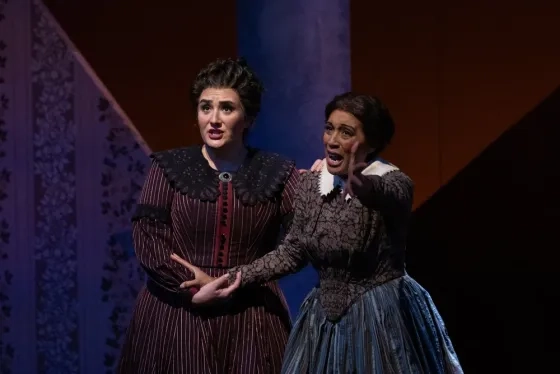
Ashley Dixon and Jacqueline Echols McCarley in 'Intelligence.' (Credit: Dave Pearson)
Specifically wanting to avoid making Intelligence into a period piece, Heggie says he thought about the women at the heart of the opera as contemporary figures. "I don't want to impose something on the characters. I want them to tell me, which is why you have to spend so long developing the story, learning about it, and working with the librettist—and then respond to what's on that page rather than impose something that isn’t there."
"But I'm a theater guy, so I also try to find the theatricality, the drama, the honesty and integrity of the characters; to honor and amplify those voices," he says before joking, "So, you know, that's all."
There's a deep vein of emotion in Intelligence that hinges on one very likely, though unprovable, twist. Bowser was afforded a relatively high level of privilege within the Van Lew household for a woman born enslaved. She was educated in the North; allowed to travel to Liberia to see if she wanted to move there permanently (she declined); and crucially, was baptized and married in the white church the Van Lews attended. "When I talked to historians, they said the only explanation was that Elizabeth and Mary Jane were actually sisters. So this also led us down another path for the opera, because in addition to uncovering the secrets of the Confederacy Mary Jane is uncovering the secrets of her own life, and confronts Elizabeth with this at the end of the opera, telling her, 'We're sisters, but not family.'"
But that moment wasn't originally part of Intelligence, and Heggie only pivoted after the SFCM reading in early 2023. "We had an audience, people from Houston, people from here, donors and other people involved in the creation of the opera, an amazing cast … but we didn't have the ending right," he recalls. "We found out in that workshop and in front of that audience that we needed a new ending. And that wouldn't have happened if we hadn't had the workshop here."
"We had dodged Mary Jane getting angry with Elizabeth and confronting her," Heggie says. "This was our chance to hear the opera come off the page without staging, and we heard what needed fixing loud and clear. It’s so important to have the right ending. It was the SFCM workshop that really changed everything."
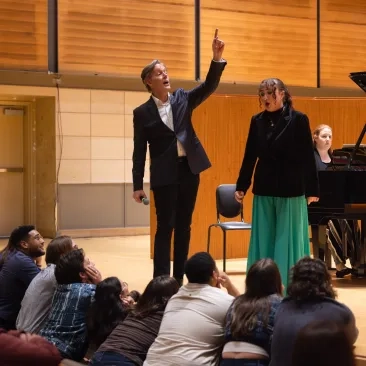
Jake Heggie and student Jordan Riek.
"You don't want 'nice' people around you during a workshop," Heggie says. "'Nice' people will tell you what they think you want to hear. You want kind people who are going to be honest, because it is a very vulnerable moment. You need to know if it's working or not. So you need your friends and people who care about you and want your work to succeed to take you aside and say, 'You know what, I love you, and I love this, this, and this, but this is really not working. We had that at SFCM, and it was the moment when the whole thing finally came together."
Heggie's own mentors go into the teaching lineage he's now a part of at the Conservatory. "They guided me and helped me and told me things like, 'As your friend, I need to tell you something: Don't wear those pants. Don't go out like that,'" he jokes.
"The wonderful thing when you're dealing with talented people is you bring it up, you discuss it, maybe you offer perspective, maybe you offer ideas or thoughts, then they make it their own in an honest way that's authentic to their own talent and vision," he says of his students. "It's not just that it's the job: It's something I really appreciate when people do it for me, so now I do it based on all the perspective I have from a whole life of doing this."
Learn more about studying Composition at SFCM.