Chamber Music Tuesday Recital Puts SFCM Honors Ensembles in the Spotlight
The annual Honors Ensemble competition gives students the opportunity to form their own consistent groups and jump-start their opportunities as working Bay Area performers

The Amaru Quartet.
Every student at SFCM has multiple opportunities for ensemble playing with their peers. But for the second year, the Conservatory's Honors Ensemble competition has allowed students to form their own groups and compete for the chance to star in their own concert, receive per-performer stipends and earn status as a "first call" group for outside opportunities.
"Chamber music—any small-ensemble playing—is an essential part of a musical education," String and Chamber Music Chair (and Viola faculty) Dimitri Murrath says. "It sharpens the listening skills of the players and trains them to breathe and lead together. Holding the Honors Competition every year gives an opportunity for any student at SFCM to push themselves to prepare and present a performance and get feedback from professionals. As faculty, we notice it focuses students to prepare to the best of their abilities."
This year, all three groups played a March concert as part of the Conservatory's monthly (and regularly sold-out) Chamber Music Tuesdays series, showcasing the range of musicianship at SFCM. Duo Panoro, comprised of Kaz Hudson (guitar) and Zoe King (clarinet), played three pieces from Brazilian composers; the Amaru Quartet played Dvořák's String Quartet No. 14, while the Soul Sextet (musicians from the Roots, Jazz, and American Music Department) played a set that ranged from classic standards by Johnny Mercer to contemporary jazz voices like Christian McBride.
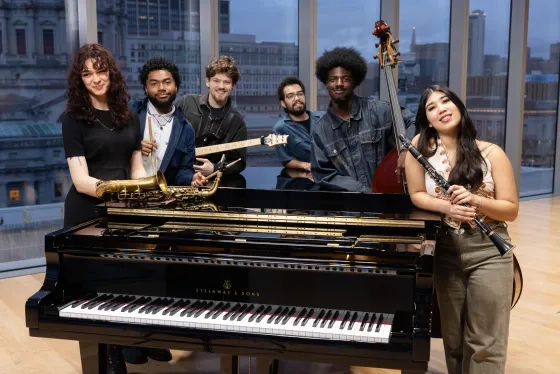
The Soul Sextet (from left: Kira Agrell, Miles Turk, Beck Holland, Emmett Van Leer, Ashton Dixon, Xitlatti Estrella).
Across every group, students almost unanimously spoke about how much they enjoyed the range of influences in their group. Soul Sextet pianist Emmett Van Leer says, "We're all really into different styles outside of the straight-ahead and groove jazz we play as a group, including avant-garde, big band swing, rap, RnB, and rock." But the band's bassist, Ashton Dixon, said the range of influences doesn't make for tricky chemistry: "Playing with this group feels so natural. We have the same idea of what good music should sound like, and we exhibit a healthy amount of risk-taking to make moments each time."
Meanwhile, Xitlalli Estrella, who plays clarinet in the group, highlighted an underappreciated part of collaboration: "Everyone's sense of humor is really funny. It makes it a great vibe to rehearse with. Sometimes we focus too much on perfection and forget to have fun in the process, and these bandmates always remind me to have fun on the bandstand."
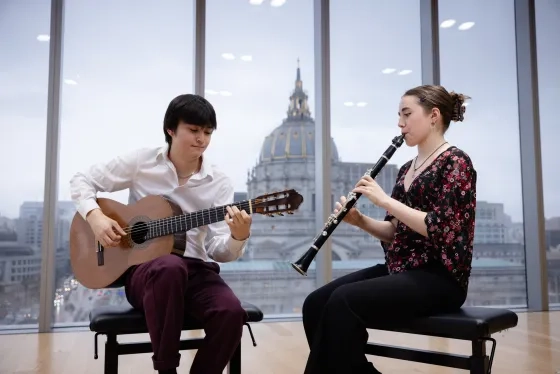
Duo Panoro (from left: Kaz Hudson and Zoe King).
Initially, the Honors Ensemble competition didn't include a duo, but Hudson and King entered anyway and made such an impact that they were included in the winning groups regardless. The pair met when composer Sérgio Assad, a longtime friend of SFCM's Guitar Department, visited the Conservatory and simply gave Hudson the full scores to an album of guitar and clarinet duets he'd released.
Both Hudson and King have played in jazz ensembles despite not strictly focusing on the genre at SFCM. "We both wanted to find a way, in our classical concerts, to incorporate some of the other kinds of music that we like. The Assad stuff specifically is a really nice middle ground, because it's not standard classical but it can pass in a concert." Their collaboration snowballed into an entire recital as a duo as they added repertoire from other Brazilian composers, and in one case, another student, Thomas Stenzel.
Hudson and King independently suggested that their success as a duo is based on the fact that they're "better musicians than when we started here," but King puts a finer point on it: "Our backgrounds inform how we look at classical music and we have that in common. That's rare, to have someone who sees music the same way as you."
Chamber group the Amaru Quartet have distinguished themselves beyond "just" excellent individual musicianship: Their preternatural sense of blending and working together as a group is immediately apparent, as seen in this video of their coaching session with SFCM Violin and String and Piano Chamber Music faculty Wonhee Bae.
Cellist Lindsey McKenna joined the Amaru Quartet this fall. "The quartet had a few different formations, and I joined in September 2025. I had never joined an existing group before, and I was just really excited because I had always wanted to play in a really dedicated quartet."
Like others, McKenna cherishes the collaborative dynamics of the group. "That's really hard to find," she continues. "Four people who really want to work together all the time … We're able to musically agree on a lot of things, and are all equal in our commitment to the group. That's really nice, because it helps us not only develop individually and work on our own technical skills as players, but also shape the group sound, which takes time."
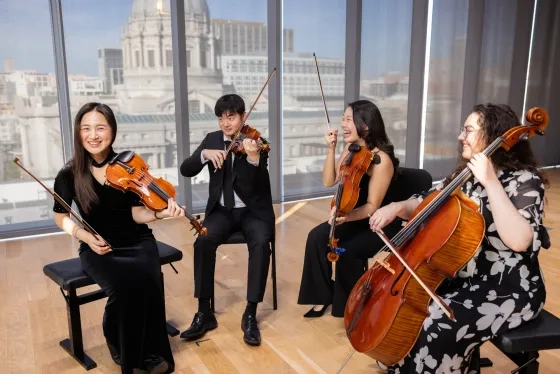
The Amaru Quartet (from left: Jeeihn Kim, Mark Chen, Erika Cho, and Lindsay McKenna).
SFCM Community Engagement Manager Kevin Rogers, who performs regularly with his chamber group, Friction Quartet, highlights how student groups at SFCM benefit from a supportive and collaborative environment.
"All of us were deeply inspired by the chamber music program. We had a number of dear mentors who supported us after school, giving us advice, performing with us, coaching us, and recommending us for festivals and concert opportunities. If you really believe in your ensemble and show up and put in the work, the relationships you built while in school stay with you. It's a tight-knit circle of support that enables you to have a chamber career if you can dream it."