Alam Khan of Ali Akbar College of Music Joins SFCM Faculty
Alam is the son of Ali Akbar Khan, one of the most famed practitioners and ambassadors of Hindustani music in the 20th century.

Alam Khan.
Thousands of years of improvising tradition are coming to SFCM.
For the 2026-2027 academic year, the Technology and Applied Composition (TAC) Department's Composer-Performer course will be taught by sarod player Alam Khan, son of Ali Akbar Khan, one of the most famed ambassadors of Hindustani music in modern times.
Alam serves as Director of Instrumental Music at the Ali Akbar College of Music (AACM) in San Rafael, founded by his father. Khan's appointment builds on the already-established relationship between the College and the Conservatory: AACM sitar instructor Arjun Verma has taught Hindustani music at the Pre-College and collegiate levels previously.
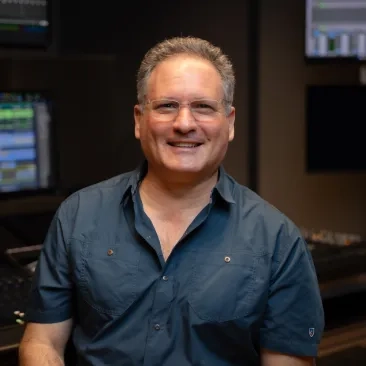
"TAC students are, by nature of the program, spending a lot of time 'in the box,' as they say—composing and working in computers," TAC Executive Director Matt Levine (right) says. "But they're lacking in what I call 'the embodiment of music.' By that I mean the physical experience of playing and connecting with music and everything that goes along with it: Singing, dancing, not being afraid to make noise and mistakes."
"I'm really excited about having Alam here," Levine continues, "because he's absolutely the perfect person to teach that. Not only is he a profound master at Indian classical music, which is something of a miracle and nearly impossible to achieve, but he's done a lot of contemporary music, collaborating with artists like Beats Antique and Grand Tapestry on innovative beat-driven music."
Alam's father, along with Ravi Shankar, helped popularize Hindustani music on the international stage, and the elder Khan was as much an instructor as performer. He came to the United States in 1955 on the invitation of violinist Yehudi Menuhin and founded his first school in Berkeley, CA in 1967. Four years later, he was part of George Harrison's Concerts for Bangladesh, two star-studded fundraising events later released as a GRAMMY-winning album that sold over 5 million copies internationally. Ali Akbar was also a five-time GRAMMY nominee and recipient of both the MacArthur "Genius" Fellowship and the National Endowment for the Arts' National Heritage Fellowship.
Alam began a rigorous program of study with his father at just 7 years old in the "guru and shishya" (teacher and student) tradition. He began touring and performing with his father in 1996, and as he says, "pretty much bypassed traditional schooling. I graduated from high school two years early because my teachers like, 'Well, you're obviously going to be a musician. You can just take the proficiency exam and legally leave high school after your sophomore year. So I did."
But at the time, Khan says, "I didn't really know if I was gonna be a full-time performer or a teacher. My role was pretty much just to spend as much time with my father as possible and absorb as much material about music and life as I could. It does kind of go with the territory for Indian classical musicians that when you reach a certain level, you'll start teaching, but to what degree and for how long is different for every person. But when my father died in 2009, classes were supposed to start two weeks later, and I had to rise to the occasion, so I've been teaching ever since then."
Khan and Levine stress that the two-semester Composer-Performer course isn't designed to teach Hindustani music as it would be taught at AACM. "I want the students to walk away with somewhat of an understanding of different concepts drawn from Hindustani music, but in service of the relationship they have with their art," Khan says. "I've performed with all kinds of musicians—Vijay Iyer, Blake Mills, Bob Weir, the San Francisco Symphony, Del Sol Quartet—and I've produced music with Ableton, Pro Tools, MPCs."
"I live between worlds," Khan continues. "I'm half-white, half-Indian, so race, culture, all of it is mixed for me. I was brought up on grunge and hip-hop and other music just as much as I was classical. So it took me a long time to find that space in between, and now what I do is honor the tradition I learned first. I say Indian classical music is my lighthouse: Any time I go too far out in the oceans of creation, let's say, and I'm getting too far out there and not really sure of where I am, I can always look back and see that lighthouse guiding me back to where the shore is."
He continues, "I'm coming from this traditional thing, but I use the same tools as the TAC students. And since this is about them as composer-performers, I also want them to be able to use their instruments as much as those technical tools—to tap into what it is to really connect to music with their bodies."
"Learning about the musical traditions of other cultures—Indian classical and African drumming, in my case— absolutely changed my whole understanding of music," Levine adds. "It was probably the biggest single change in terms of my trajectory as a composer, and it opened my ears and my concept of what music even really is in a way that was just completely transformative. I want our students to have that opportunity as well."
Learn more about studying Technology and Applied Composition at SFCM.