SFCM Remembers 'Susannah' Composer Carlisle Floyd with Recital Helmed by Three of His Collaborators
The Voice Department's tribute to Floyd debuts Oct.16 in the Bowes Center's Barbro Osher Recital Hall at 7:30 PM.

Carlisle Floyd.
Faculty members from SFCM's Voice and Composition Departments—all of whom worked with the man behind Susannah and many other beloved works—are uniting to celebrate composer Carlisle Floyd's centennial.
Susanne Mentzer, Voice Department Executive Chair Richard Cox, and the Conservatory's Diane B. Wilsey Distinguished Professor of Composition, Jake Heggie, all knew and worked with Floyd to varying degrees, and have put together a career-spanning survey of Floyd's oeuvre.
"He was a real mentor to me," Heggie says. "I met him in 1996, '97, right when I had met Terrence McNally, and we were coming up with an idea for an opera, eventually settling on Dead Man Walking. Carlisle had so much great perspective to offer, and he was willing to be there for me, and it was enormously helpful to know that someone of his stature was interested."
Patricia Racette in Susannah at the San Francisco Opera. Racette is an Opus 3 Artist, one of the companies that comprise SFCM's Global Creative Alliance.
Mentzer, meanwhile, met Floyd when she was working as a receptionist at the Houston Grand Opera, during the composer's tenure as co-director there. "I had to fly to Dallas to audition for him," Mentzer recalls. "So that year I was in the Opera Studio, and you know, he would come to concerts and say hello. I think it was the following year that he was writing a song cycle, some 20 songs about Emily Dickinson, and he wanted me to premiere it! I was so young. He and a pianist, we would get together for a couple of months, where he'd bring in a piece and I'd try to read his scribble and, um, panic. I was just really lucky to have had him just hand me his manuscripts and say, 'Here, go ahead. Let's try this, let's try that.' He was very open to changes, and I was literally 24 or 25."
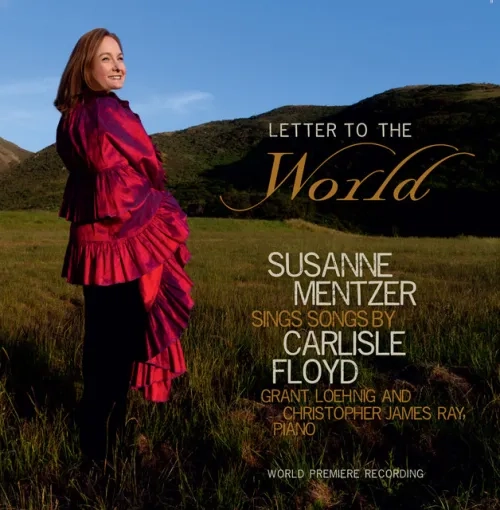
Susanne Mentzer's 'Letter to the World' album cover.
Mentzer has two releases celebrating Floyd's work: The world premiere recording of his Wuthering Heights, released in June 2016, and Letter to the World: Songs by Carlisle Floyd, which she successfully crowdfunded herself in 2013. Of the latter, Floyd offered his own high praise of Mentzer: "Mentzer's is definitive in every regard…I frankly can't imagine the cycle of songs (with its very broad span of moods) being more artfully or more movingly performed."
Cox graduated from Florida State University, where Floyd taught for many years. "About five years into my career, they invited me back to perform, one of his pieces with him directing us," Cox remembers. "And, my first show at Lincoln Center was Susannah. Then, interestingly enough, when I auditioned for the Metropolitan Opera, I sang the scene from Of Mice and Men that we've programmed for this evening."
Floyd's work strongly reflected his upbringing: He was raised by an itinerant South Carolina preacher, and his work adapted classic narratives from the American South, like Of Mice and Men or Willie Stark, an adaptation of All the King's Men, a fictionalized account of Louisiana politician Huey P. Long. Floyd's best-known work, Susannah, took its basis from the Book of Daniel in the Old Testament of the Bible, transposing the story to Tennessee and incorporating hymns, square dances, and folk-like songs.
In their obituary for Floyd, The New York Times quoted David Gockley, former general director of Houston Grand Opera, as saying the opera world was unfairly tilted against a through-and-through Southerner like Floyd. "If you're not part of the Northeastern establishment, specifically the New York scene, you have no status. Because Floyd always lived and taught in Florida or Houston, he has been regarded as a regional figure, when in fact he is a national one."
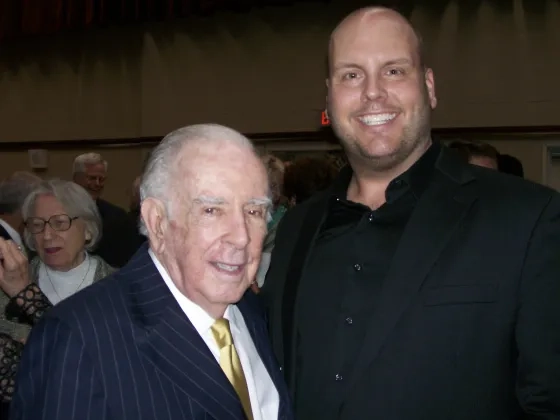
Carlisle Floyd with Richard Cox.
"Carlisle really wrote what he knew," Cox says. "And he was a Southerner, so that doesn't always translate into broad appeal the same way a Puccini opera does, because the stories are so niche." Heggie adds, "Carlisle didn't know how to be false. He was very honest with his writing and his choice of stories that he wanted to tell. He would lean on his heroes and use that vernacular and all of that information that was part of his creative being, but he never tried to pretend to be someone else because it was in vogue."
All three teachers underscore the learning opportunities Floyd's compositions provide. "His pieces have a very wide range—and part of that is large intervallic leaps—so you have to understand how to balance your voice across that to perform them successfully," Mentzer says. She also points to the Emily Dickinson cycle as worthy of study by budding librettists. "Floyd did all his own libretti for these settings—using not only her poems but her personal letters. That blew my mind, because it's really hard to do, but he got really into the emotional meaning of everything, and he had enough dramatic sense to make sure the core emotions came out."
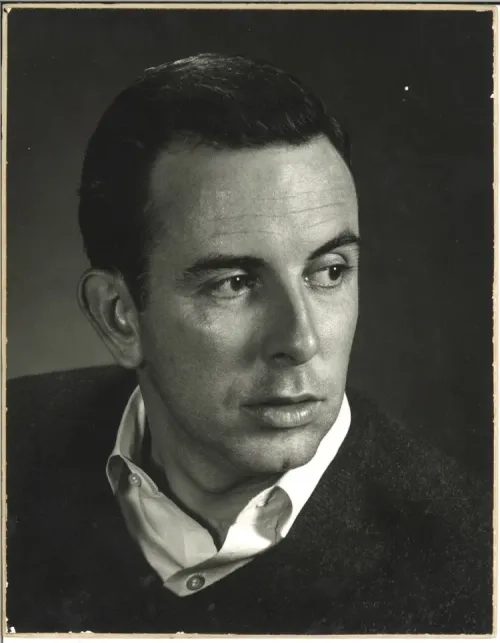
Carlisle Floyd.
"Feeling just oozes out of his work," Mentzer continues. "He knows how to touch your heart. When I saw Willie Stark for the first time, I was crying by the end."
"It is sophisticated music, while also having that connection to folk and these 'simpler' kinds of American musical style," Cox adds. "But even though it's hard, it's always singable: It always comes back to how good he was with melodies."
"He wrote so naturally for the voice," Heggie says. "His libretti are the emotional architecture that expands and takes you to different places. They are always idiosyncratic for the voice, and challenging, yes, because it will test both extremes of a voice, but he didn't do that to be gratuitous, to write just for show. It always made sense for the character and for the moment, and that's something I admire in the integrity of his writing. It's challenging, because it needs to be."
Outside of the notes on the page, one of Heggie's interactions with Floyd has remained with him. "The East Coast reviews were devastatingly horrible for Dead Man Walking," Heggie says. "And after those, I decided I should never read reviews again—and I still don't—because now that language is in my head and that's what I'm thinking of."
Heggie continues, "And Carlisle had warned me about that. He said, 'Don't get that language in your head because then you're not writing with your creative voice, you're writing to impress those other voices.' So he called me after the reviews of Dead Man came out and he said, 'Jake, this is Carlisle. I just read your New York Times review and I wanted to say, 'Welcome to the club.'"
Reserve your tickets to the Voice Department's celebration of Carlisle Floyd here, or learn more about studying Voice or Composition at SFCM.