Six-Time Grammy Winner Giancarlo Guerrero on Conducting, the SFCM Orchestra, and Mentoring Young Conductors
Guerrero conducted the Nov. 14 Orchestra concert and worked with SFCM conducting students.

Giancarlo Guerrero with the SFCM Orchestra.
With enough GRAMMYs to break a poorly installed shelf, Giancarlo Guerrero's reputation precedes him: Tenures with the Minnesota Orchestra, Eugene Symphony, Nashville Symphony, Wrocław Philharmonic, and the Sarasota Orchestra (among others) have made him one of the most visible conductors of the 21st century.
Guerrero is also represented by Opus 3 Artists, one of the partner companies in SFCM's Global Creative Alliance, which brought him to SFCM to work with the Conservatory's Orchestra and Music Director Edwin Outwater's conducting students Grace Wahlen and Jason Gluck. At the Orchestra's November 14th concert, Guerrero also took the podium for Béla Bartók's The Miraculous Mandarin, Op. 19.
Below, Maestro Guerrero answers the SFCM's Newsroom questions about his career, working with orchestras, and his advice to young conductors.
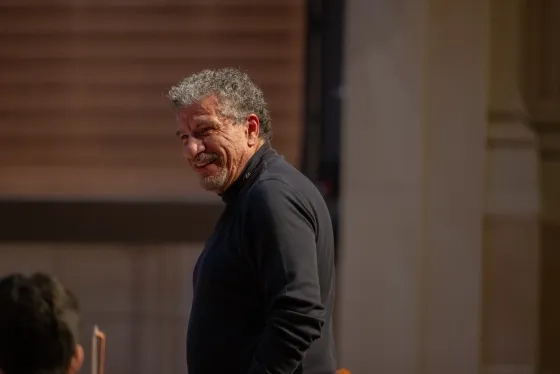
Giancarlo Guerrero.
Do you remember the first time music "clicked" for you?
I guess the first time I heard an orchestra was when I was in the National Youth Symphony Orchestra in Costa Rica. I'd never heard a symphony orchestra live, ever, and I was, what, 12 years old? It was a Saturday morning and I was doing my normal lesson, and then I heard all these sounds coming from a big room, and I went in, and it was this full orchestra playing Schubert's "Unfinished."
I just remember being completely blown away by it. The music just went through my body and it hasn't left. But also, you have to remember that all of us who started music, like any after-school activity, at first, it's a hobby. You have a life outside of school: I had my school friends, and I had my music friends. That was the greatest type of peer pressure: We were all pushing each other, so if I didn't practice enough, I would be out of the orchestra, which meant I wouldn't see my friends. So that was the most important incentive for me to keep up my chops, and to this day it's the same thing: I want to keep playing with my friends in Boston and Chicago, you know? That's how it started, really: as a social thing.
But then of course, for all of us [gestures around], there is that line that you cross over, then you realize, "You know what? I wanna dedicate my life to this."
When was that moment for you?
That was a longer journey. You know? What happens is, you get so much more immersed into it that once you realize that, you're far too deep to get out.
I came from a non-musical family: My father liked mariachi music, and my mother liked Julio Iglesias. So Mozart, Beethoven, they were completely alien in my house. When I graduated high school, I did what most kids did in Costa Rica at the time, which is to go for a normal career. I went to engineering school for one semester, and very quickly I realized I was going to be a horrible engineer: This was not my calling.
And I realized music was no longer just an after-school activity: It was something deeper, something such that I could not imagine doing anything else. Also, I think I had to leave to save humanity, you know, because the last thing anyone would have wanted is for me to have done the math behind some engineering project: People would have lost their lives [laughs].
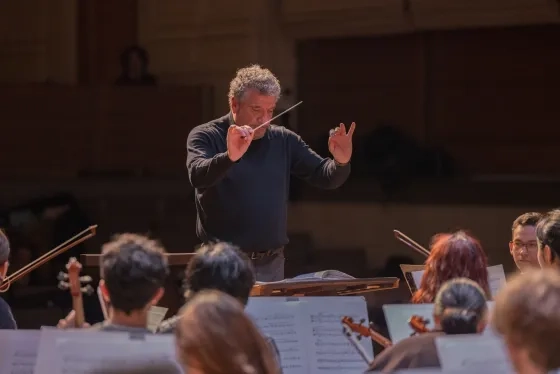
Giancarlo Guerrero in the Caroline H. Hume Concert Hall.
What do you remember from or about the Costa Rica National Youth Symphony Orchestra that made an impact on you?
Gerald Brown, the conductor. He was the founder of the youth orchestra in Costa Rica. American, former horn player—he came to Latin America as part of the Peace Corps in the 1960s and then was hired, basically by the president of Costa Rica, to create the youth orchestra there, the first in Latin America. He was really a guru, a mentor for all of us. The first time I ever saw him, he was this very elegant man with a stick. And you know, all these kids in their teenage years, they listened to him with these beautiful gestures, and I was fascinated: Musically, watching somebody who could lead in that way was unlike anything I'd ever seen, and it made a huge impact on me.
When did you decide to make conducting your focus?
It was an accident, like most people. I was a percussionist, so I was in the back of the orchestra. I always say that I first was in the back with two sticks, and then I went to the front with one. And I used to make fun of conductors [laughs], so now, I don't get offended at all when I'm rehearsing and I hear it happening, because I know what's going on.
Honestly, what happened was, I took the mandatory conducting class that all music majors have to take. And I delayed that as much as I could, until my junior year, and I took it because I had to. I still have all the videos of the classes, and I could not have taken the class less seriously. For me, I just needed the credit.
But then the conducting teacher, I guess, saw me and he said, "You know, maybe because you're used to having a stick in your hand, and you have good rhythm," which, for a conductor, is imperative. He said, "I think you have a very natural talent as a conductor." And honestly, I didn't know what he was talking about. Like I said, I still have those videos, and I still don't know what he was talking about! But I guess that's the mark of a great teacher: Somebody who can recognize something that you yourself don't know.
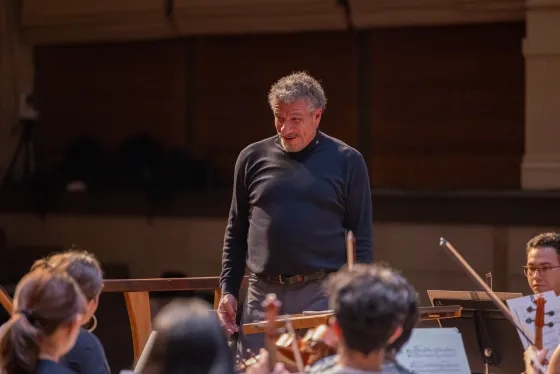
Giancarlo Guerrero at the San Francisco Conservatory of Music.
I wasn't ready to give up my dreams, so I was still playing in the orchestra, but I started looking at conductors and thinking, "What is this that they do?" I looked up more scores, learning how to study and analyze them. I also started listening to more music beyond just the percussion stuff, because that's a 20th-century invention, so I had to do a lot of catching up with Brahms and Beethoven, Mendelssohn, Schubert, Bach, Mozart, Haydn. So when I was going to pursue my master's, I decided to do both.
Eventually, I went back to Costa Rica and the pendulum started going one way, and all of a sudden I found myself doing more conducting things. It's been a long time since I've played as a percussionist. I do have a dream to someday go back and play in a community orchestra or something because I miss it, honestly. Conducting is a very lonely profession, and I miss the camaraderie of playing in an ensemble.
You won a number of GRAMMY Awards during your tenure with the Nashville Symphony. Coming in to work with them, when did you realize, "Oh, we have something here?"
I was very lucky that when I became music director, they had just moved into a new hall. So institutionally, the orchestra changed overnight. All of a sudden, the audience and everybody came to realize how really good the orchestra was in a proper space.
So I came in at a very important moment of great, decisive change—not only for the orchestra, but for the city. A world-class orchestra with a world-class concert hall: Now you can develop a sound. You can develop a culture. And because of that, I had the necessary support in the community to do commissions and champion American repertoire, because let's face it, when I came in, I didn't think that the world needed another Beethoven cycle.
Nashville is Music City, an American Music City—we just happened to be doing it in our field of classical music. So we felt that it was relevant to send that message in Nashville. And of course, it garnered all the attention and awards. Nothing gave me greater joy than when I went to Australia or somewhere, and I would go to a record shop, and there were our recordings.
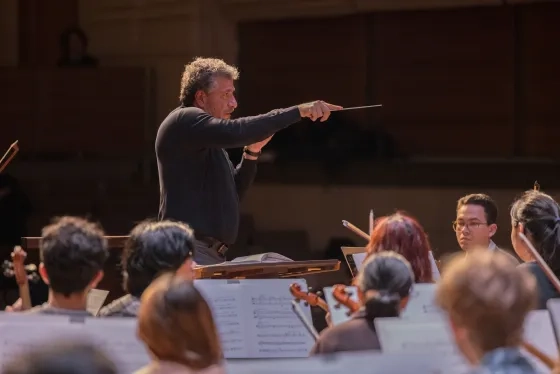
Giancarlo Guerrero conducts the SFCM Orchestra.
When you come in to work with a new ensemble, how do you assess them? What's going through your head?
I always talk to young conductors about this: Early on, you want to be accepted. That's just a common human emotion: You want to be liked as a conductor, and it's harder as a student because you have to conduct your peers, and then you have to go to class together.
So I always tell them to develop a personality: who you are on the podium, who you are musically. And that takes time. It takes a long journey. That's why the whole conducting career takes endless podium hours. The first time you conduct Beethoven Five, trust me, you're going to step on every landmine. The second time, not so many. By the third time, you know where everything is.
Good musicians can smell a fraud from a mile away. They can tell when a conductor is up there and they're not being honest, just making things up. There are orchestras that eat conductors for breakfast: They see weakness, they smell the blood in the water, and they just go for it. But then other conductors come in, and the music is so embedded in who they are, and they know exactly what they want and how to get it, that musicians will jump over that cliff, go against their own instincts, and do whatever the conductor wants because they've inspired them. But you get to that point after many years of stepping on a lot of landmines.
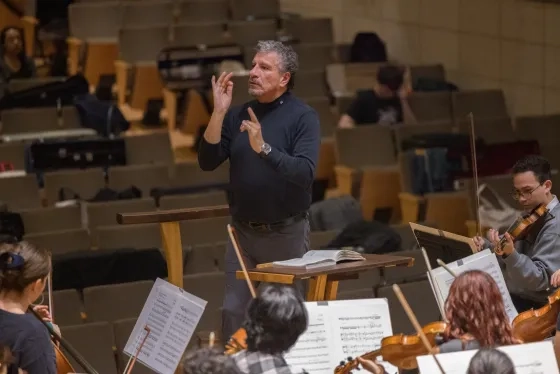
Giancarlo Guerrero.
Do you have any memories of when you were in the former camp?
Oh, my God. I mean, remember that 90 percent of this is chemistry, and you can't manufacture that. Some orchestras, I show up, and they connect with me. Others, I could be trying to land a plane [waves arms frantically] and they're not looking up. How many times have you seen a great conductor with a great orchestra, and they love each other, and that same conductor goes to another orchestra, and they hate each other? That's just human nature: Not everybody is your best friend.
I do live by one motto, though, and this is something I tell young musicians, especially conductors. It's better to have bad ideas than no ideas. That's what musicians want. And, come on: [Try to] get two musicians to agree on anything, let alone 100. But if somebody has the ability to get over that through conviction, through cajoling, through diplomacy, that's when the magic happens.
Early, you go to an orchestra for the first time, and you're excited, and then they never call you back. So then you start questioning yourself: "Oh my God, what did I do?" That's normal. It's natural. "My career is over. I'm gonna go into another line of business. What if I become an engineer again?" You know? And then, little by little, you learn to accept that you're going to win some, you're going to lose some.
What's it like working with young conductors at places like SFCM?
I take time regularly to work with young musicians, because I find it very refreshing and inspiring to see the incredible level that is coming from beneath. It also reminds me how lucky I am that I have a job, because honestly, the level of talent is unbelievable. Technically, the conductors I see have everything and more than I ever had when I was at that stage 40 years ago. The question is, how do you focus all of it into a nice little package that will make a career? Because the music is the easy part of this. That, we know how to do.
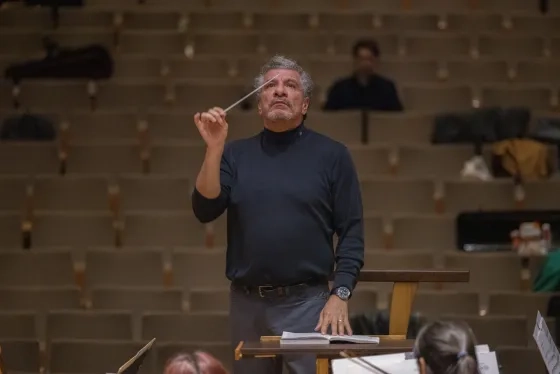
Giancarlo Guerrero at SFCM.
But when you finally make it into the business, you realize that as a music director, you spend 5 percent of the time conducting. The rest of it is organizing and planning and fundraising and marketing and everything else. That isn't taught anywhere: You're going to learn it on the spot, and you're going to make a lot of mistakes. So I like to spend time with Grace [Whalen] and Jason [Gluck], who are on that edge of their careers, to tell them the music part of it is going to be what keeps them happy. That's what they should always focus on: Every conversation, every discussion, begins and ends with the music. It would be nice to only do that, but no. I wish somebody at that stage would've told me these things, so I feel that it is absolutely imperative that I spend as much time with these young musicians as I can. To not only watch what they do and be inspired by what they do musically, but more importantly, to share what my own journey has been so that hopefully they will find their own path.
Learn more about studying Conducting at SFCM.