Award-Winning Student Composer Brayden Meng Discusses His Piece 'To Decipher Birdsong'
Meng studies with Mason Bates, who helped craft his Highsmith Award-winning piece.

Brayden Meng with the SFCM Orchestra.
At the SFCM Orchestra's Fall 2026 season-opening concert in September, birdsong was in the air.
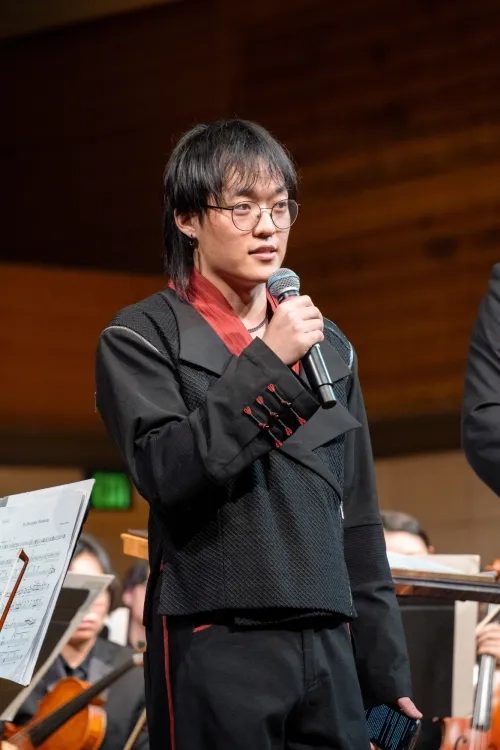
Brayden Meng.
Specifically, Composition student Brayden Meng's Highsmith Award-winning composition To Decipher Birdsong, which was in good company that evening, receiving its world premiere before works by Jennifer Higdon and Sergei Prokofiev.
The Conservatory's annual Highsmith Competition grants winners the premiere of their submitted work at an SFCM Orchestra concert. Composition Department Chair David Conte calls it "in many ways the most important opportunity for our student composers … Historically, many of our most gifted composers have won this prize, and it has enabled them to move forward into the professional world of commissions and college and university positions."
Meng's journey into composing actually began with a humorous semi-misunderstanding of the craft. Though he'd been playing piano and violin since he was very young, he recalls, "I first decided to be a composer after I wrote a piece for myself in junior year of high school, a violin concerto. I'd actually been writing kind of naturally along with my studies actually learning the instruments."
"But," he continues, "I thought all the composers were dead. I remember thinking that there was, like, no one 'new,' because everything I learned was from, you know, old composers. My thought process was, 'You know, someone's gotta write new stuff or we're gonna run out of things to play.'"
Meng calls that first concerto a pivotal moment. "I had the opportunity to play it with the orchestra as a soloist. All the rehearsals and work I put into both writing it and performing it made that performance probably one of the most meaningful moments of my life. That feeling—being able to perform my own work and share it in my own voice—is just unsurpassed by anything."
To Decipher Birdsong came out of two artistic residencies Meng completed in 2024. The first, an annual project called 300 Migratory Birds, was part of the Aranya Theater Festival in Qinhuangdao on China's eastern shore, for which 300 international artists spend 300 hours collaborating while living on the beach of the Bohai Sea. "I got to meet a lot of artists, whom I'd say are almost lifelong friends now," Meng recalls. "Learning about their art forms and how they coincide with music influenced my ideas about community and finding one's voice."
Next, Meng journeyed to Woodstock, New York, where he stayed at the Woodstock Byrdcliffe Guild. "It was in the woods on a mountain and I had a lot of time to just sit in nature and listen to real birds. So a lot of the bird analogy stuff comes from these two specific events that summer, and Woodstock was when I started writing this piece."
One of Meng's influences is the Japanese composer Takashi Yoshimatsu, whose work frequently incorporates avian themes. "I started off by trying to capture the sounds of the bird calls around me," Meng says, "along with the soft sound of wind through the leaves—this kind of ambient white noise that was constantly surrounding me."
Along with what he jokingly calls "all the bird sound stuff," Meng continues, "there were people working in pottery and other crafts nearby, so I heard the sounds of their tinkering. And that's how the piece came together: I had maybe a page or so of these textures and I went to my studio teacher Mason Bates and said, 'I want to make something out of this.'"
The piece was actually called Mechanical Bird for a long time, Meng says, owing to that workshop environment and how he'd sketched the piece "in such a sequenced kind of way at first that was almost like, mechanical. As I kept writing it, there would be these swells I thought of as flocks coming in, as well as these twists and turns that become much more organic." A rhythmic figure later in the composition, he says, is meant to evoking the slow flap of a pair of massive wings.
Thematically, the narrative of the piece—of a lone mechanical bird imitating what it hears before it's spurred to leave its workshop home after witnessing an actual flock of birds flying overhead—is a purposeful echo of Meng's journey as a musician. "The mechanical bird realizes there's more to this like, Pinocchio-becoming-a-real-boy journey than just being able to replicate what it hears. In order to kind of actually produce birdsong, you can't just decipher it, it has to be something that you experience."
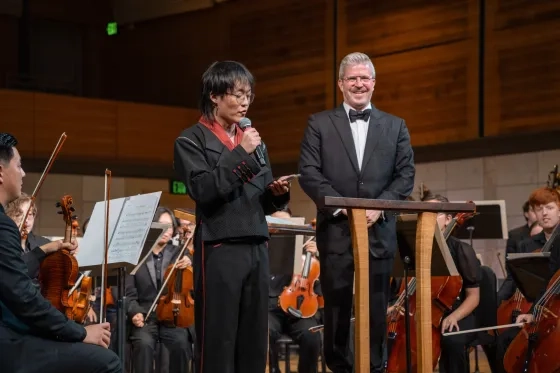
Brayden Meng with SFCM Music Director Edwin Outwater.
As a younger composer, Meng says he would "listen to my influences a lot, and try to maybe replicate what they were doing and change it a little bit, play around with it. My music is selfish in a way where it really is a combination of everything I love to listen to. If I like it, I'll take it, and put it all together into this, like, 'What I Love' kind of thing and share it with the world."
"But ultimately," he says, "it was honestly only after coming to the Conservatory and meeting so many other music friends and then going out and really getting a lot more of my own life experiences that I was able to create music that was more authentic to me. For composers, those moments are so important for us to be able to develop that voice. You can't just do it in a practice room by yourself."
Learn more about studying composition at SFCM.