SFCM/UCSF Collaboration Explores How Variations Appear in Nature and Music
'Art Reflects Life: Mutations, Variations, and Improvisation' debuts at SFCM on Wednesday, October 14 2026, 7:00 PM.

Jason Hainsworth and Edwin Outwater.
SFCM's ongoing collaboration with UCSF's UCSF Edward and Pearl Fein Memory and Aging Center continues in October at the Conservatory with an event exploring the different ways in which variations in genes and in music occur.
UCSF professors—including Aimee Kao, MD, PhD, a neurology professor in the Fein Center—will share the stage with Conservatory students and faculty, including SFCM Music Director Edwin Outwater and Roots, Jazz, and American Music (RJAM) Executive Director Jason Hainsworth on a multi-media presentation involving discussions, presentations and performances.
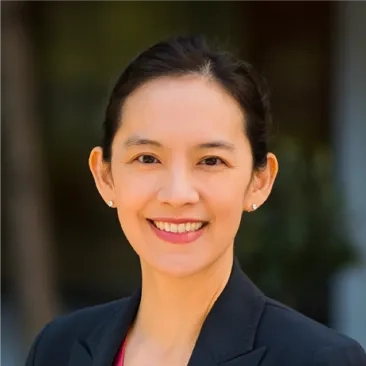
Aimee Kao, MD, PhD.
Kao has been with UCSF since 2001. She's long been a neurology specialist, focusing on treating people with memory disorders and other neurodegenerative diseases, but she identifies a post-doctoral fellowship with Dr. Cynthia Kenyon, who Kao says is "considered the mother of aging research," as the moment she drilled down into her specialty.
"She introduced the idea that aging is genetically regulated, as opposed to things 'just falling apart,'" Kao says, a turning point in our conception of the aging process. "I started my own lab in 2011/ 2012, and we study the really upstream causes of neurodegenerative diseases," she continues. "And because for a long time people were really confused about what caused neurodegenerative diseases, the only thing we knew was that aging and gene mutations both contribute. That's how I became—and this is one way I describe myself—a molecular geneticist."
Kao actually studied piano in her childhood, practicing 90 minutes a day from when she was six years old until she turned 17. "I became skilled at playing notes, is what I would say," Kao says, before adding, "but I just did not get it. I like music, I listen to music, I enjoy playing. So there wasn't anything negative about it for me, but I didn't get the emotion of music much later in life, and I just didn't love it the way some people do."
Though she'll be broadly speaking about "how variance, and to some degree mutations, are nature's way of experimenting, and that they've really helped humans evolve," Kao's focus is intently zoomed in on the actual mechanisms of the aging process at the tiniest level.
"What we do in the lab now," she continues, "is think about how we can promote healthy longevity? Because it's not just about increasing our lifespan, it's about staying cognitively, sharp, and resilient, and maintaining our overall health. For example, there's a part of our cells called the lysosome that helps to degrade molecules that are no longer needed or are damaged. These little organelles are the most acidic part of our cells, and that's key to how they 'do their job.' But with age, it's harder for lysosomes to stay acidic, so they become less efficient. So we're really thinking hard about how to, on a molecular level, keep lysosomes acidic. Because we think a lot of neurodegenerative issues flow downhill from there."
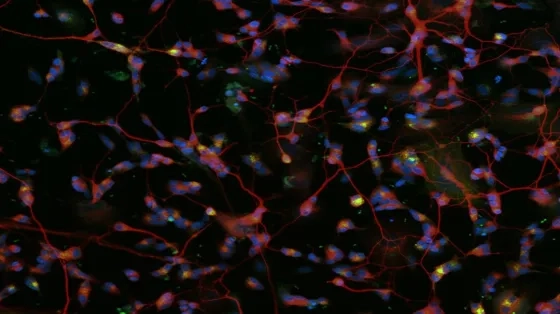
Micrograph of a kind of neuron expressing a synthetic fluorescent protein that helps to measure when the pH level of a lysosome is declining.
Where Hainsworth and Outwater come in is demonstrating how these principles work in music—though they'll be zooming more broadly out to the ideas of variation, rather than the acidity of our lysosomes.
Hainsworth has worked with UCSF for the past four years, partnering with their Global Brain Health Institute's fellows to, in one case, go into San Francisco's Bayview neighborhood to a senior living facility, take a survey of what kind of music its residents listened to growing up, and then asking RJAM students to come up with arrangements of those songs to perform at the facility. (There are a number of studies on the positive benefits of music as it pertains to age-related conditions.)
"You can absolutely see the effects pretty quickly," Hainsworth recalls. "And not just on an older musician, talking about people who grew up listening to certain classic songs. Hearing those again sparks something in their brain that more traditional medicine cannot."
"Edwin and I will be trying to demonstrate some of the commonalities between the brain science and how we as musicians interact, particularly in instances of, as it says in the program, variation and mutation," Hainsworth continues. "That could mean taking a simple melody, and starting with its original form, changing one note of it at a time. That can change the entire color and character of a melody, which could be the difference between making something sound like it's in a major key, which people commonly associate with happy, to a minor key."
"You can also achieve that by changing what's contextualizing that melody," Hainsworth says. "You reharmonize everything underneath it and can completely change its character and vibe. Part of what we do as jazz improvisers in our solos is establish an improvised theme and develop it with these techniques, or by playing it backwards. John Coltrane actually does that in the melody to a song called 'Miles' Mode' from the album Coltrane in 1962: He plays it and then reverses it—'retrograding' it."
Outwater is no stranger to melding science and music. He collaborated with The Institute for Quantum Computing on a show called Quantum: Music on the Frontier of Science that drew parallels between how our understanding of physics has, in ways, paralleled the evolution of music as well as a program called Beethoven and Your Brain with neuroscientist Daniel Levitin, author of This Is Your Brain on Music.
"There are these patterns, like the Fibonacci sequence, that appear in nature," Outwater says. "And patterns like that—with variations—are very much a part of classical and jazz music in different ways. One way of looking at them in classical is that they're planned out by a composer, who's almost acting like a creator deity or figure, purposefully introducing patterns and evolving them in the writing. Whereas in jazz and improvisation, those variations are more random, spurred in the moment by group interaction. So that gets into the whole discussion of how much of biology is a master plan with recurring patterns vs how much of it is shaped by randomness?"
"When I work with scientists I've always felt that, obviously, music isn't going to explain biology or genetics," Outwater says, "but music is a good lens to look at things through, because you can feel things and get a sense of them in a visceral way, rather than just with an intellectual understanding."
To that end, Outwater is purposefully presenting in a way that doesn't alienate either side of the science and music aisle. "I'm very conscious of the scientists listening who are not experts in classical music, but who are obviously very intelligent people," he says. "So to make everything work in a very clear way that hits home with listeners who aren't as steeped in this music is really important to me."
SFCM, the Fein Center, and the Global Brain Health Institute have been partnered since 2019, offering a series of public talks and musical performances highlighting scientific research and core principles of music through each institution's experts. "There are things we know through music that we can't know through other means," SFCM President David Stull says. "We seek to explore these questions."
Reserve your seat to Art Reflects Life: Mutations, Variations, and Improvisation here.