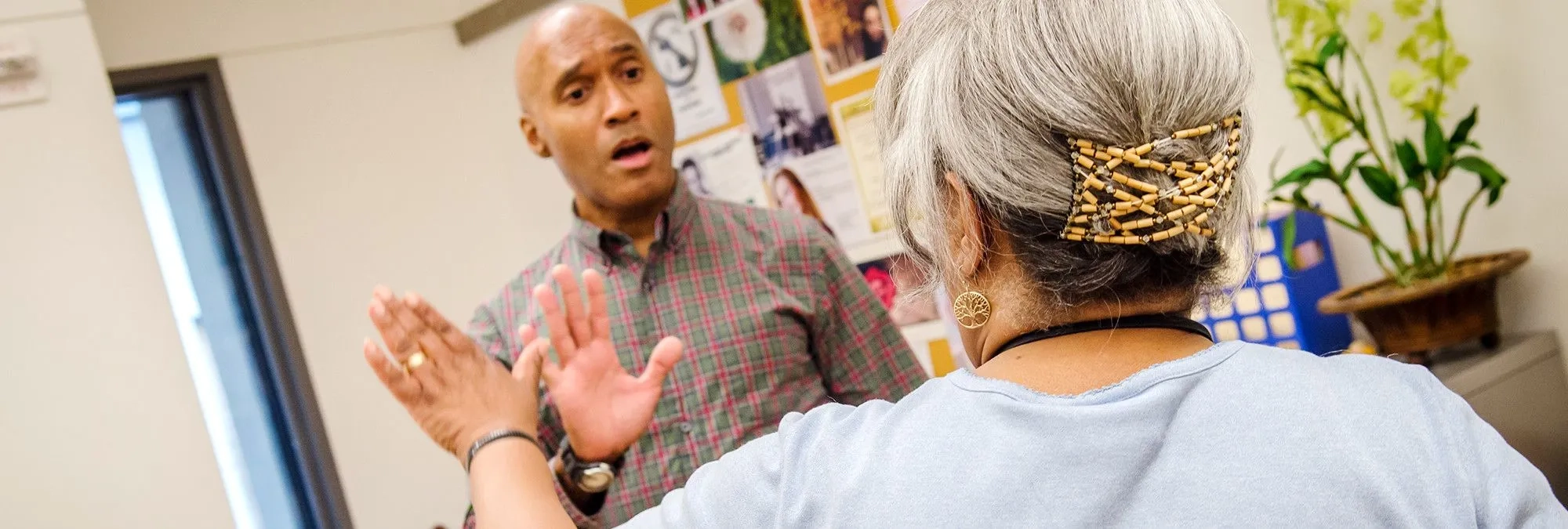
Alexander Technique
Alexander Technique
Instructor: Danielle Thomas
Dates: 6:30-8:00 PM (PT) on Mondays from September 28 to December 7, 2026 (no class on November 23)
Location: In-Person at SFCM
Tuition: $450
Do you experience tension while practicing or performing?
Do you find yourself slouching at your desk, holding your breath under stress, or feeling stiff after long rehearsals? The Alexander Technique can help you move more efficiently, reduce unnecessary tension, and perform with greater confidence and ease. Whether you're a professional musician, an amateur, a student, or simply someone curious about moving with greater ease, this course offers practical tools to help you feel and perform at your best!
Used by musicians, actors, dancers, and public speakers around the world, the Alexander Technique provides practical skills that can improve posture, and help people move with greater range of motion, ergonomic efficiency and confidence. By learning to recognize habitual patterns that interfere with coordination you'll discover how small changes in awareness can lead to significant improvements in body comfort, performance, and everyday activities.
Musicians often find that the technique helps reduce performance anxiety, prevent overuse injuries, and improve breathing. But the benefits extend far beyond music, supporting anyone who wants to improve balance, coordination, presence, and overall well-being.
Throughout the course, you'll explore the principles of the Alexander Technique through guided movement activities, simple everyday movements, and individualized hands-on instruction. We also draw on current research in anatomy, neuroscience, motor learning, and music education to better understand how the body learns and performs at its best.
Participants are encouraged to apply what they learn to their own interests, whether that means playing an instrument, singing, public speaking, exercising, working at a computer, or simply moving through daily life with less strain.
No previous experience is necessary. Everyone is warmly welcome!
Winds and Brass
Brass Ensemble
Instructor: Christian Paarup
Dates: 6:30-8:30 PM (PT) on Tuesdays from September 8 to November 17, 2026
Recital: Tuesday, November 17, 2026 at 7:30 PM in Cha Chi Ming Recital Hall (the Bowes Center)
Location: In-Person at SFCM
Tuition: $550
The Brass Ensemble is open to adult brass players who are eager to play in a chamber music setting with fellow brass players in the community. No audition required. Rehearsals will be held weekly. The ensemble will prepare a program of mixed styles and genres for a public performance. The program will be determined based on enrollment and ability levels. This ensemble is intended to be a relaxed, fun environment with repertoire that will be appropriately challenging for everyone!
Please contact Christian Paarup with any questions at
pcnnehc@fspz.rqhude.mcfs@puraapc
.
Guitar
SFCM Guitar Community Ensemble
Instructor: Scott Cmiel
Dates: 4:30-6:00 PM (PT) on Saturdays from September 19 to November 21, 2026
Recital: Saturday, November 21, 2026 at 5:00 PM in Cha Chi Ming Recital Hall (the Bowes Center)
Location: In-Person at SFCM
Tuition: $475
The SFCM Guitar Community Ensemble consists of guitarists interested in performing ensemble works in a wide range of musical styles from the Renaissance, Baroque, Classical, Romantic, and Modern periods. Under the direction of Scott Cmiel, the guitar ensemble will prepare for a performance at the end of the semester.
Each member will be assigned one of four parts and play together in a section with others playing the same part. We want players of all levels to be able to participate so while some members will play difficult music others will have their parts adjusted so they can play beautifully and with an expressive interpretation. Everyone is asked to learn their part before each meeting so during rehearsal we can work on the interpretation of each piece.
There is no need to be a virtuoso - good tone, good memory, and enthusiastic attitude are all that’s required.
If you have any questions about the orchestra please contact Scott Cmiel at
fpbgg.pzvry@fspz.rqhude.mcfs@leimc.ttocs
Indian Classical Music
Raga Compositions Level 1
This course is not offered for the Fall 2026 semester.
Explore the rich world of North Indian Classical Music through repertoire based in traditional raga (melody form) and tala (rhythm cycle). The beautiful compositions of Ali Akbar Khan will be the focus of the class, in additional to specialized training exercises to strengthen the basic skills of melody, rhythm, phrasing, and ornamentation.
Open to all instrumentalists with basic playing ability. Students also have the option to rent a sitar or sarode.
Offered in partnership with the Ali Akbar College of Music. Learn more about the Ali Akbar College of Music.
REGISTER NOW
Music Theory
Introduction to Music Composition
Instructor: Mauricio Rodriguez
Dates: 7:00-8:30 PM (PT) on Wednesdays from September 16 to November 25, 2026 (no class on November 11)
Location: Synchronous online
Tuition: $375
This course is an introduction to music composition to stimulate students to compose original pieces of music in different styles, formats, and media (instrumental, vocal, digital). Specific topics include: contemporary chord structures and harmony; music form; rhythm and melodic composition; lyric composition and music analysis. No composition experience is necessary, but the ability to read music is required.
Students are expected to achieve the following goals at the end of this course:
- Compose original pieces of music in different styles and formats
- Understand the principles of harmony and its relation to music form
- Develop composition systems and their respective music notations
- Analyze and critique compositions with respect to style, form, structure, and lyrical elements
All the materials for the course will be provided by the instructor in the form of PDFs that include lecture materials, practical activities, and assignments. PDFs will be shared over email one week before each session. Students are encouraged to print these materials ahead of time to make annotations and follow in-class activities.
Piano
Piano Workshop: Music of Debussy and Ravel
Instructor: Jacqueline Chew
Dates: 7:00-8:30 PM (PT) on Wednesdays from September 9 to November 18, 2026 (no class on November 11)
Recital: Wednesday, October 28, 2026 at 7:30 PM in Sol Joseph Recital Hall
Location: In-person at SFCM
Tuition: $475
Choose your favorite work by Claude Debussy or Maurice Ravel! Selection of piece should precede the first class.
Classes 1 - 5 will be devoted to repertoire analysis and practice techniques. Solos should be completed before Class 6
Classes 6 - 7 will focus on performance preparation
Class 8 - Performance on October 28
Class 9 - 10 will focus on new repertoire
Limited to 8 pianists.
Piano Repertory – Wednesdays
Instructor: Jacqueline Chew
Dates: 5:30-7:00 PM (PT) on Wednesdays from September 9 to November 18, 2026 (no class on November 11)
Recital: Wednesday, October 28, 2026 at 7:30 PM in Sol Joseph Recital Hall
Location: In-person at SFCM
Tuition: $475
Pianists will work on repertoire of their choice. Selection of piece should precede the first class.
Classes 1–5 will be devoted to repertoire analysis and practice techniques. Solos should be completed by class 6.
Class 6-7 will focus on performance preparation
Class 8 - Performance on October 28
Class 9 - 10 will focus on new repertoire
It is helpful if pianists are familiar with major and minor keys, triads and seventh chords, and key signatures. Limited to 6 pianists.
Repertoire level: Bach Two-part Inventions, classical sonatinas, Chopin Waltzes etc.
Voice
Musical Theatre Vocal Performance Workshop
Instructor: Dr. Phillip Harris
Dates: 6:00-7:30 PM (PT) on Mondays from September 14 to December 14, 2026 (no class on November 23)
Recital: Monday, December 14, 2026 at 7:30 PM in Sol Joseph Recital Hall
Location: In-person at SFCM
Tuition: $650 (includes a $100 collaborative pianist fee)
The class explores the many performance aspects of vocal music in a supportive and positive atmosphere, with a focus on musical theater. We work on vocal freedom, stagecraft, drama, and many other aspects of this incredible art form. Singers should be prepared to perform each class (memorization preferred) and can choose to work on one or more songs throughout the entire semester. A staff pianist will be available to work with students at all in-person classes. The session culminates in a live performance in one of the recital halls at the end of the semester.
This class is available only to amateurs and semi-professional students with singing experience. At least 3 years of private lessons are required. Enrollment is limited to 10 students.
Vocal Performance Workshop
Instructor: Dr. Phillip Harris
Dates: 6:00-7:30 PM (PT) on Tuesdays from September 8 to December 8, 2026 (no class on November 24)
Recital: Tuesday, December 8, 2026 at 7:30 PM in Osher Salon
Location: In-person at SFCM
Tuition: $650 (includes a $100 collaborative pianist fee)
The workshop explores the many performance aspects of vocal music in a supportive and positive atmosphere. Singers can bring classical (opera/art song/oratorio), jazz, pop, and gospel/sacred music. We work on vocal freedom, expression, language, technique, stagecraft, drama, text, and many other aspects of this incredible art form. Singers should be prepared to perform each class (memorization preferred) and can choose to work on one or more songs throughout the semester. A staff pianist will be available to work with students at all in-person classes. The session culminates in a live performance in one of the recital halls at the end of the semester.
The class is available only to amateurs and semi-professional students with singing experience. At least 3 years of private lessons are required. Enrollment is limited to 10 students.