History

We go way back.
Early Years
In the fall of 1917, pianists Ada Clement and Lillian Hodghead opened the doors to the Ada Clement Piano School at 3435 Sacramento Street, in the remodeled home of Lillian’s parents. A school newsletter from 1924 described that first semester of 1917: “The faculty numbered five. The school had four pupils. Four studios were used and only two were equipped with blackboards. Three pianos were donated by the Misses Ada Clement and Lillian Hodghead.”
Recognizing the need for a music conservatory on the West Coast, the school incorporated in 1923 as the San Francisco Conservatory of Music, offering classes in many orchestral instruments as well as theory, composition, and voice.
|
Image
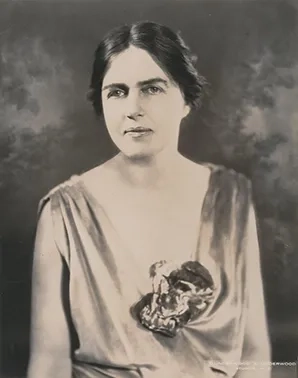
Ada Clement Ada Clement |
Image
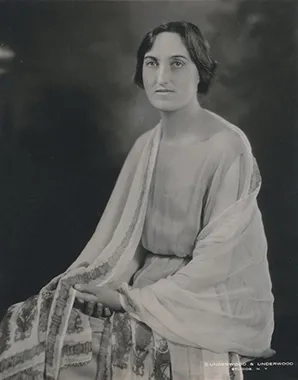
Lillian Hodghead Lillian Hodghead |
In 1924, the Conservatory engaged composer Ernest Bloch to teach a five-week summer course, which was a resounding success. Ada Clement said of the course, “We had a splendid big class which more than covered our expenses. And what a wonderful look into the great principles of music! The whole town was quite aroused.” Bloch was hired as artistic director the following year. During his tenure, Bloch’s musical vision, international reputation, and skill as a teacher spurred a tremendous expansion of the school. When Bloch left the Conservatory in 1930 to compose full time, Ada and Lillian resumed leadership of the growing institution.
|
Image
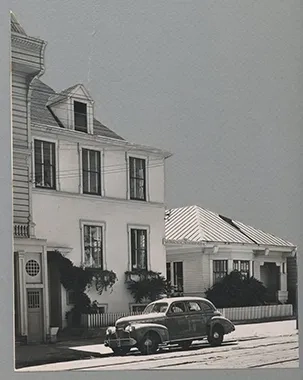
3435 Sacramento Street 3435 Sacramento Street |
Depression years at the Conservatory were difficult, but the school survived. Lillian Hodghead wrote of this time, “The Depression allowed no extra pennies for music lessons. The spirit of service that has always been in our school was exceptionally fine at that time. Without endowment or subscribers or scholarship funds we managed to work together and survive. All of us gave of our time and strength to help the gifted who could not pay.”
Chamber Music
Chamber music has been an important part of the Conservatory since its early years. In 1926, the Conservatory welcomed its first faculty chamber ensemble, the California String Quartet. In 1948, the internationally renowned Griller Quartet established a summer school at the Conservatory, attracting students from across the United States. The ensemble returned for three more summers and served on the faculty for many years. In 1952 the Alma Trio began a summer residence program, and the ensemble’s pianist Adolph Baller subsequently joined the Conservatory’s faculty.
Sunset Years
In 1951 Albert Elkus, recently retired chair of the U.C. Berkeley music department, was appointed director of the Conservatory, a post he held until 1957. One of his first priorities was to find the school a new home. In 1956, the Conservatory moved to a 1928 Mission-style building at 1201 Ortega Street designed by architect Louis Christian Mullgardt.
|
Image
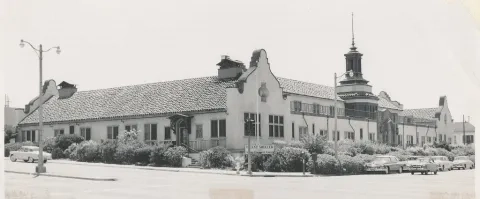
1201 Ortega Street 1201 Ortega Street |
Musicologist Robin Laufer succeeded Elkus in 1957. Under Laufer’s direction, the Conservatory reached a major milestone in 1960, becoming the first music school on the West Coast to receive accreditation from both the Western Association of Schools and Colleges and the National Association of Schools of Music. Upon his appointment to the Conservatory Laufer wrote, “San Francisco has become one of the leading cities in the world from the standpoint of international interest. Its unique geographical position, climate, growth and reputation as a cultural center make it worthy of every effort to put the Conservatory of Music on a level with the best that the East has to offer.”
Appointed president in 1966, Milton Salkind guided the Conservatory through its next great period of expansion. During his 24-year term, collegiate enrollment soared from 42 to over 250. Salkind wrote, “It seems to me that one of our most significant functions is to make people aware of the greatest national resource that we have—our gifted youth. Unless we nurture, cherish, and develop the musical potential of young people, then our hope for developing these abilities in young musicians has a hollow ring.”
Salkind initiated a community service program at the Conservatory, and increased performance opportunities for all students. By expanding master classes, he brought the professional music world to the Conservatory, with visits from such artists as Alfred Brendel, Leon Fleisher, Placido Domingo, Beverly Sills, Yehudi Menuhin, Pinchas Zukerman, and Yo-Yo Ma.
The Salkind years also saw the birth of many events and programs that became long-standing Conservatory traditions, such as the annual “Sing-It-Yourself Messiah” and Chamber Music West, a summer festival launched in 1977 that brought together talented students, alumni, faculty and distinguished artists. The San Francisco Conservatory of Music was one of the nation’s first institutions to offer a degree in classical guitar, and a Master’s degree in chamber music.
The performance of new music also flourished during Salkind’s tenure. Building on a composition department that had its roots with Ernest Bloch, Salkind hired talents such as Andrew Imbrie, Ivan Tcherepnin, and John Adams, who was an early director of the Conservatory’s New Music Ensemble. Students and faculty premiered works by composers such as Pauline Oliveros, John Adams, Martin Bresnick, and Charlemagne Palestine. In a 1978 article about the New Music Ensemble, John Adams said, “The level of musicians has come along so far that I think we can tackle almost anything someone writes for us.”
In 1992, Colin Murdoch, who had served as dean of the Conservatory since 1988, was appointed president. Under his leadership, the Conservatory celebrated its 75th anniversary with a gala concert at Davies Symphony Hall featuring world-renowned alumni artists Isaac Stern, Jeffrey Kahane, and Hai-Ye Ni, as well as former faculty member John Adams. In 1997, the Conservatory celebrated both its own and composer Lou Harrison’s 80th birthdays with Celebrating Lou Harrison!, a multicultural four-day festival of Harrison’s music, dance, art, and poetry. Guitarist David Tanenbaum, chair of the Conservatory’s guitar department, was the festival’s artistic director.
Downtown
In 2006, the Conservatory relocated to a revitalized Civic Center campus with three state-of-the-art performance spaces, ushering in a new era of growth. Composer John Adams held a composition and conducting residency. The orchestra made its recording debut on the Naxos label. A sister school agreement with the Shanghai Conservatory of Music yielded the San Francisco-Shanghai International Chamber Music festival, an annual event hosted alternately in each city, featuring joint performances of faculty and students from each school. In 2010, the Conservatory marked the 25th anniversary of its chamber music program with a festival and special celebration honoring cellist Bonnie Hampton, the program’s co-founder and a former longtime faculty member. A new Alumni Recital Series showcases outstanding alumni soloists and ensembles in command performances. Acclaimed guest artists such as violinist Pinchas Zukerman, guitarist Pepe Romero, conductor Sir Simon Rattle, and opera stars and Conservatory Advisory Board members Frederica von Stade and Thomas Hampson continue to make frequent appearances, enhancing the Conservatory’s reputation as an international center of music education located at the cultural heart of one of the world's most dynamic cities.
|
Image
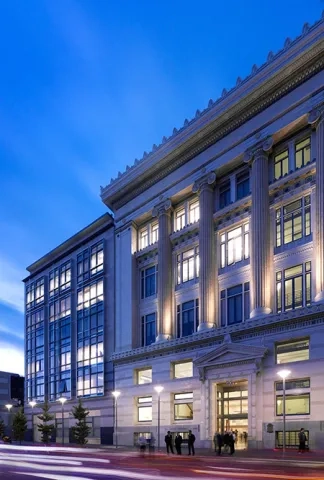
50 Oak Street 50 Oak Street |
On July 1, 2013, David H. Stull took office as president of the San Francisco Conservatory of Music, succeeding Murdoch, who stepped down after 25 years of service. Outlining his vision for the Conservatory's second century, Stull said, “Our collective ambition is to build the most innovative professional music school in the world, one that provides a transformative education of peerless excellence and launches highly successful artists and individuals who are educated for life.”
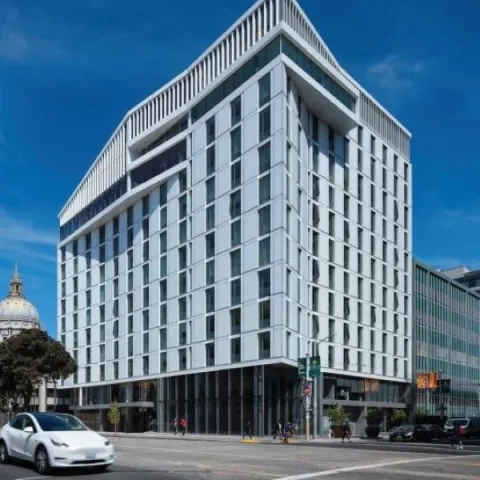
In 2021, SFCM added The Ute and William K. Bowes, Jr. Center for Performing Arts, located at 200 Van Ness Ave, dramatically amplifies the scale of opportunity SFCM provides for students and deepens our engagement with the community of San Francisco’s Civic Center. A “vertical campus” designed by Mark Cavagnero Associates, The $200 million, 170,000 square-foot Bowes Center incorporates affordable student housing, dining, classrooms, rehearsal rooms, performances spaces, faculty and partner offices, and a radio station all under one roof. The building enables students to create, learn, and share music in an integrated, collaborative environment, located within walking distance from SFCM’s main 50 Oak Street location.
Honorary Degrees
| Doctor of Music | ||||
| 2018 | Bonnie Hampton | 1998 | Zaven Melikian | |
| 2017 | Patricia Racette | 1997 | Joan K. Gallegos | |
| 2016 | Garrick Ohlsson | 1996 | Juilliard String Quartet (Robert Mann, Joel Smirnoff, Samuel Rhodes, Joel Krosnick) | |
| 2015 | Terry Riley | |||
| 2014 | Gordon Getty | 1995 | May S. Kurka | |
| 2013 | Nicholas McGegan | 1994 | William Bolcom | |
| 2013 | Colin Murdoch | 1993 | Frederica von Stade | |
| 2012 | Michael Tilson Thomas | 1992 | Beulah Forbes-Woodard | |
| 2011 | Pepe Romero | 1991 | George Perle | |
| 2010 | Warren Jones '77 | 1990 | Leon Fleisher | |
| 2009 | Peter Oundjian | 1990 | Milton Salkind | |
| 2008 | Paula Robison | 1989 | Bobby McFerrin | |
| 2007 | Donald Runnicles | 1987 | Robert Mann | |
| 2006 | Menahem Pressler | 1983 | James Schwabacher | |
| 2006 | Ruth Ann Swenson | 1982 | Shu-Chen Tan | |
| 2005 | Willene Gunn | 1980 | Margaret Rowell | |
| 2005 | Camilla Wicks | 1979 | Edo de Waart | |
| 2004 | Andrew Imbrie | 1977 | Sol Joseph | |
| 2003 | Hermann le Roux | 1974 | Isaac Stern | |
| 2003 | Nathan Schwartz, posthumous | Doctor of Humane Letters | ||
| 2001 | Laurette Goldberg | 2016 | William K. Bowes Jr. | |
| 2000 | Thomas Hampson | 2003 | Dorothy Steinmetz | |
| 2000 | Marilyn Horne | 1981 | Gordon P. Getty | |
| 1999 | Donald Stenberg | 1978 | Agnes Albert | |
To learn more about the Conservatory’s history, visit our history blog, Notes from the Past, and explore our Oral History Project website.


